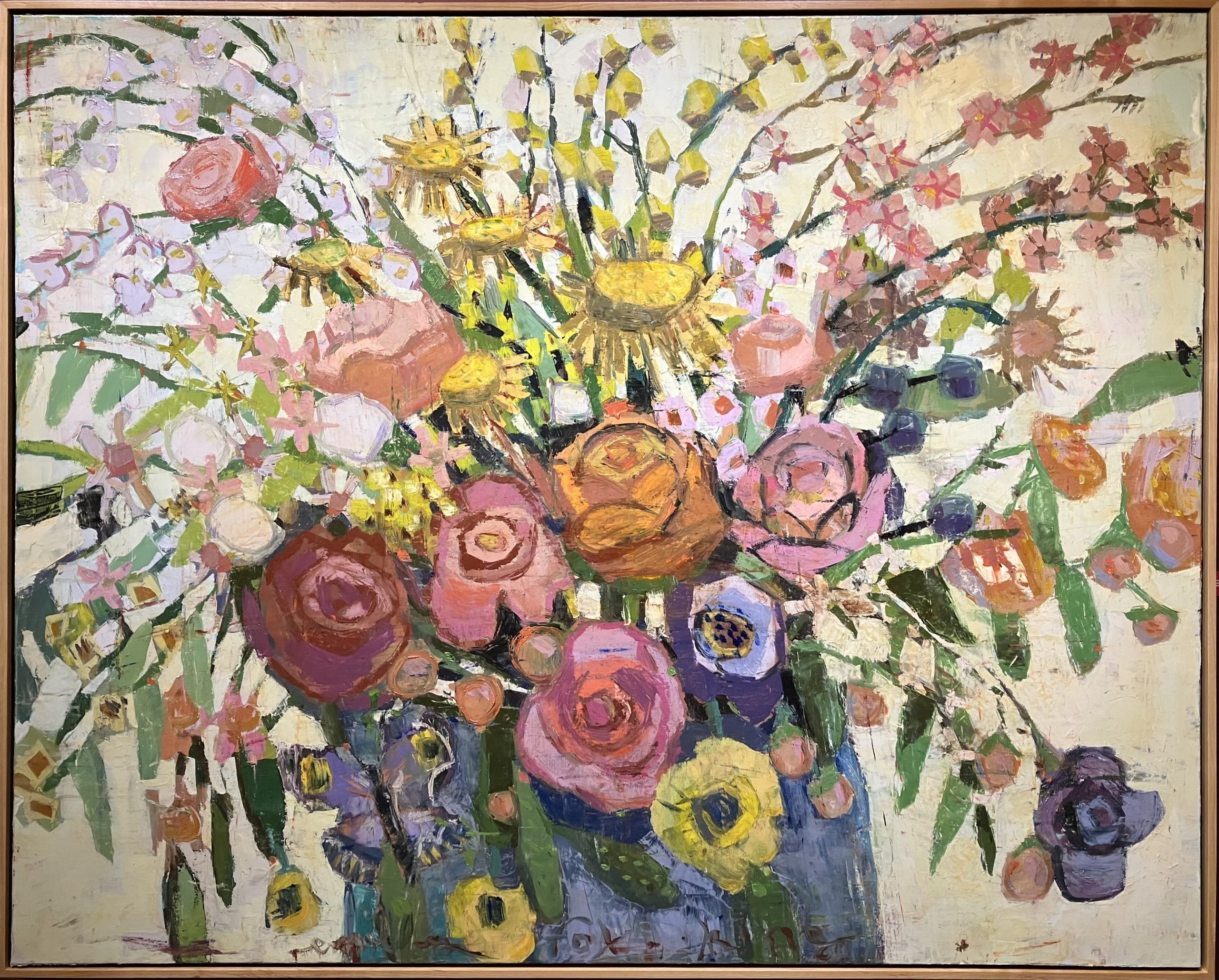
Emily Fox King, “The Road Ahead,” 48×60 in.
It says a lot about the breadth of Utah artists and their audience that Emily Fox King and Emily McPhie, the two artists showing this month at David Ericson Fine Art, each has an enthusiastic fan base in spite of the seeming irreconcilability of their contrasting ways of representing human experience. Not only that, but Fox King mentioned during her remarks that, when asked if there was anyone she would like to share the space with, she asked for McPhie. Still, while both are contemporary realists, they come from what might be thought of as opposite sides of that spectrum. As Seth Meyers says nightly, this calls for a closer look.
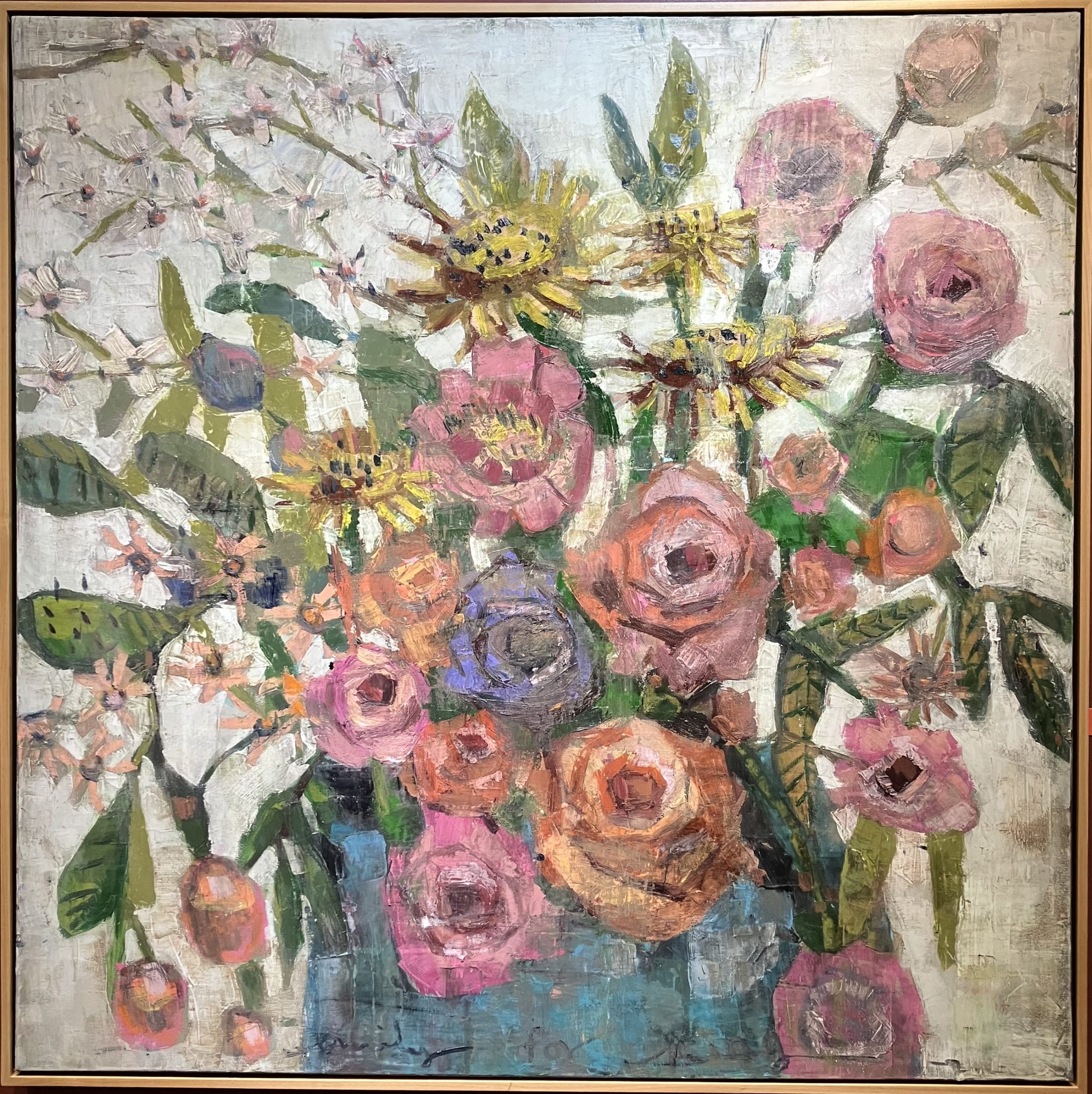
Emily Fox King is an unapologetic feminist, which, in spite of decades of real progress, is still an uncommon public posture. Much of her work presents large gatherings of mixed groups, such as family gatherings based on the sacrament of sharing food. She also spontaneously paints bold and colorful, even massive bouquets of flowers, which are both nature studies in themselves and symbolic vessels. Recently she has added landscapes to her repertoire, both domestic scenes, like “A Small Drama,” in which a clutch of yard-dwelling chickens seem to face off with a crow, perhaps competing for their feed, and arenas occupied by horses, such as “Fantasy Canyon” and “The Path Home,” with its road running past the corral on its way to the front door. While she may not have had the French Impressionist Camille Pissarro in mind, like him she paints these scenes from a raised perspective, giving a kind of bird’s eye view of both the nearby event and the distant context.
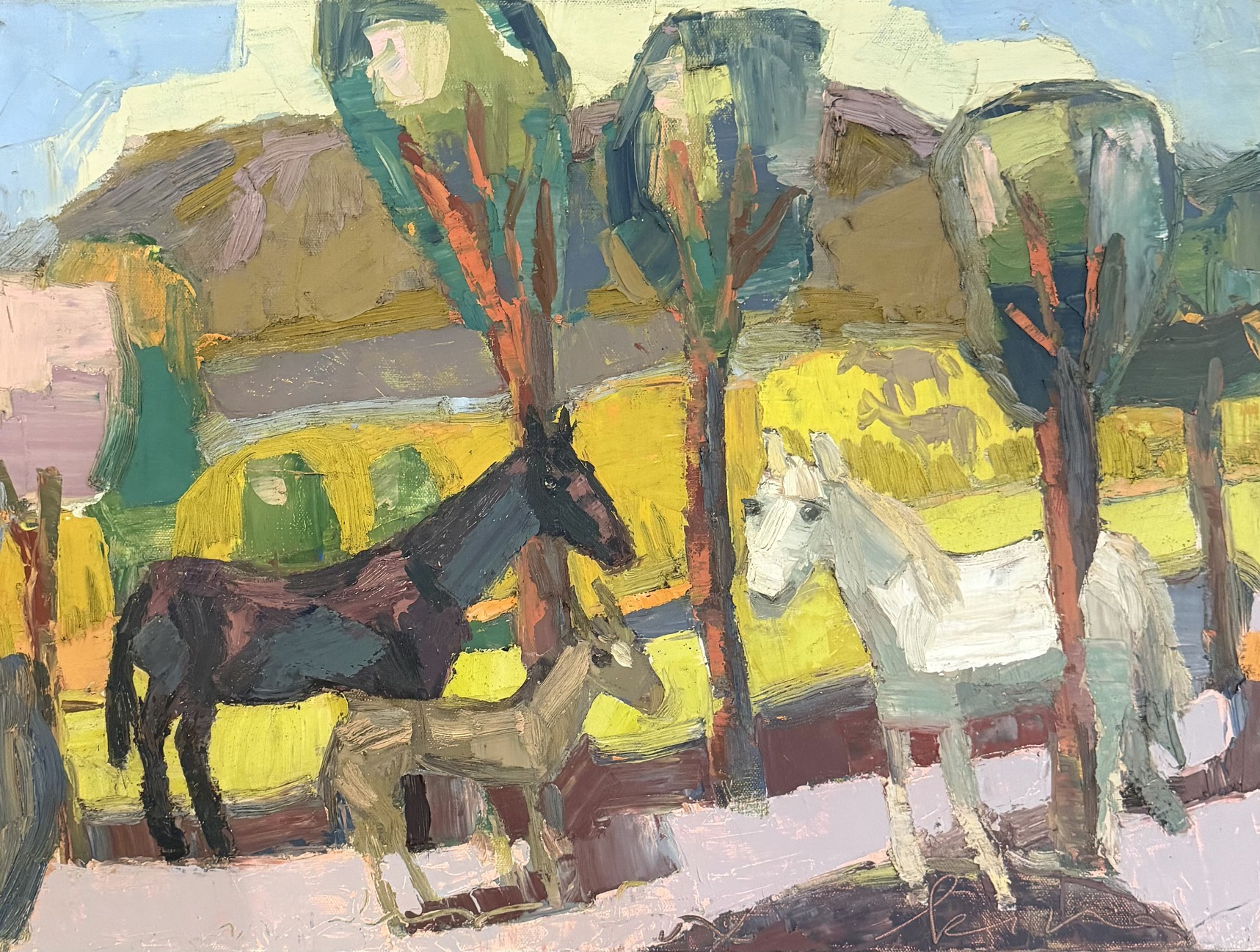
Emily Fox King, “Fantasy Canyon,” 18×24 in.
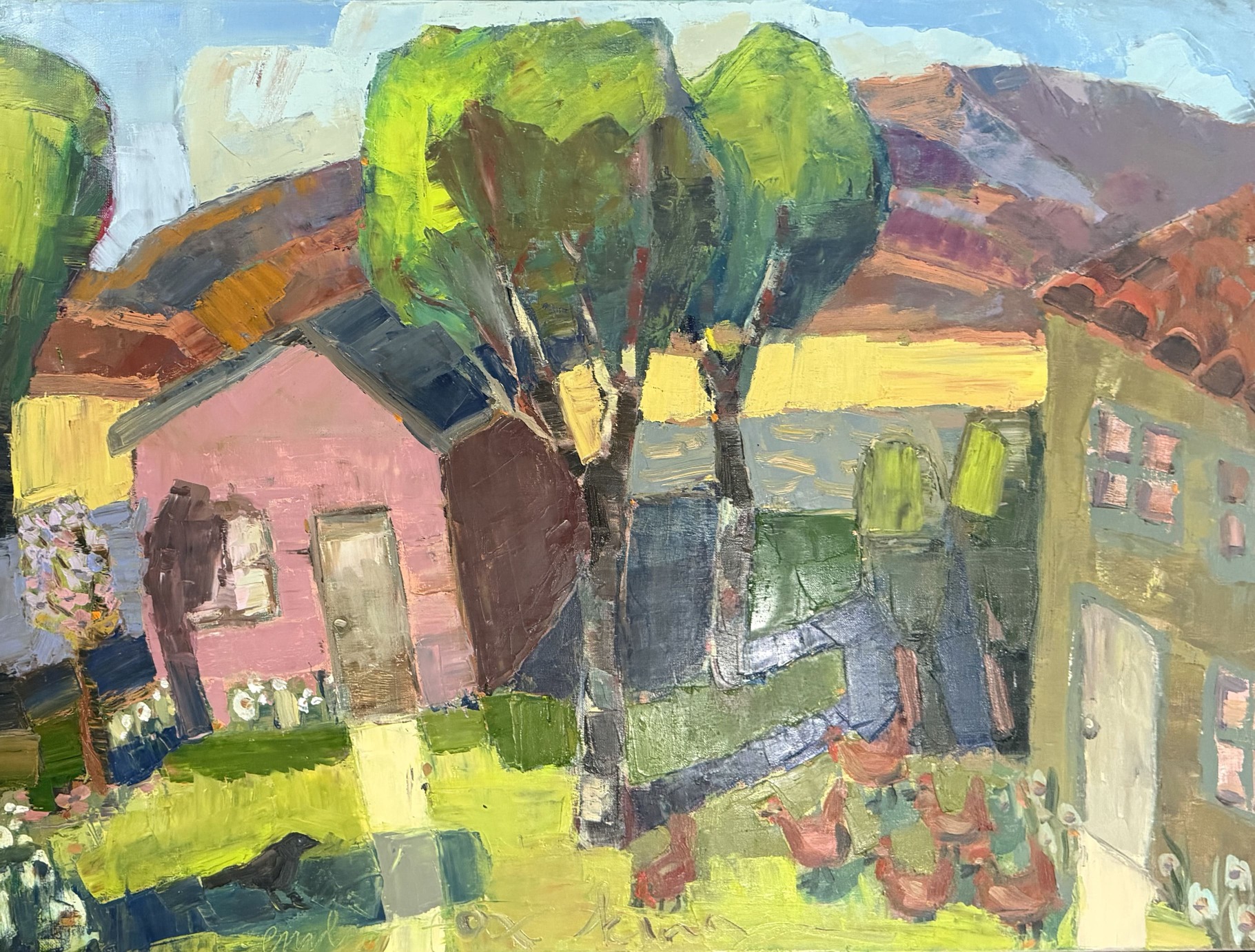
Emily Fox King, “A Small Drama,” 30×40 in.
Fox King also teaches at workshops that she organizes around the western states. Given the loose, self-evidently spontaneous manner of her painting, it’s not wrong to wonder how her method can be taught. The clue, of course, is that just because her results vary so much doesn’t mean she isn’t following a set of principles she found for herself over the years. For instance, at the Gallery Stroll opening, to make a point for a group of enthusiasts, she searched the surface of one of her florals until she found a spot of color, which she pointed out as the ground over which the painting was built. Questions followed: does she select the color based on her plan or sketches, and does she draw first or draw on the ground? Answer: she doesn’t plan or sketch, and the choice of initial color is arbitrary. Once it’s there, each next step is a response to what she finds she’s done.
She does have a repertoire of choices. She may brush the paint on in thick impasto, or not. She likes using a squeegee to manipulate whole areas, which isn’t all that easy to visualize since her results are nothing like those of the German, Gerhard Richter, who is said to be the world’s leading, living painter, and who uses the tool to produce his famous blur. Whatever the viewer thinks of Fox King’s aesthetic, there is nothing blurry about it. Her brush strokes seem deliberate and decisive. In “A Small Drama,” the tree on the left and the cottage’s landscaping are built of meticulous little touches, while both houses are made of large strokes. She also seems to have painted both houses pink, then covered the larger house with green, leaving pink in the windows. Then she decided sunlight would come from the left, and so painted the shady side of the cottage brown, but left the pink windows to show sunlight reflected.
So, this is very sophisticated visual thinking. It might remind a certain viewer of the song styling of American mid-century figures like Frank Sinatra and Tony Bennett, masters of breath control whose every word is perfectly pitched and understandable in a milieu that has come to favor noise and is often hard to follow. In this case, everything in the painting is immediately identifiable. Another fundamental that Fox King masters without preplanning is composition. Look at “As We Are,” in which flowers seem to equate with a group of persons, or “The Road Ahead.” These are elaborately balanced, yet dynamic compositions that some careful planning by other artists might not equal. They seem to breathe, as if to remind the audience of the continuity of life. Returning to her feminist perspective, we might add that not all flowers are female, any more than all women are female or, for that matter, all men male. Nature is not only fecund, but limitlessly creative. Emily Fox King paints from such a natural point of view, and if her work doesn’t seem at first as organized as some other painters, her technique is working in the background to produce works that communicate more clearly than we might expect.
Emily Fox King and Emily McPhie, David Ericson Fine Art, Salt Lake City, through Dec. 18.

Categories: Exhibition Reviews | Visual Arts