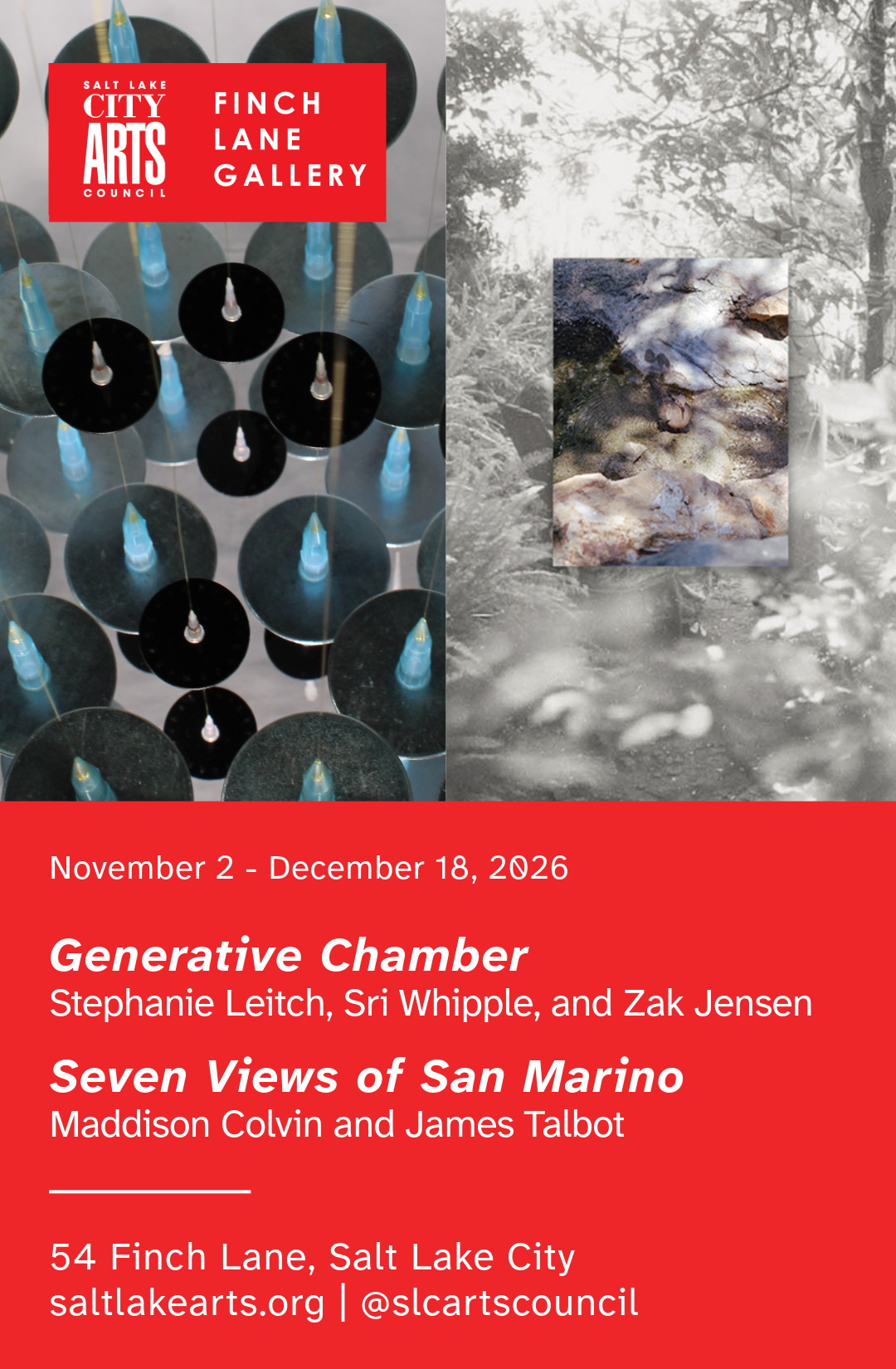
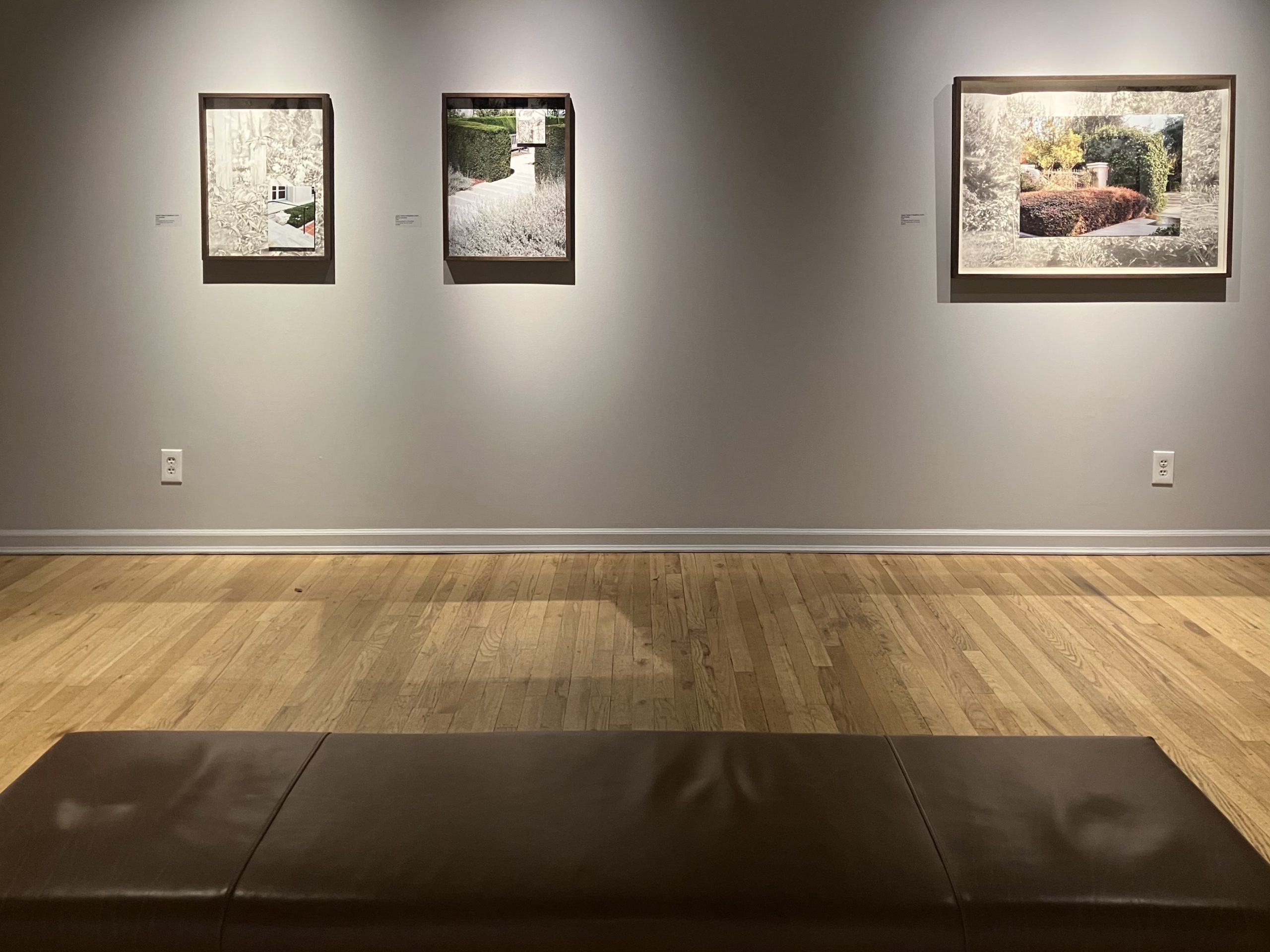
The title of the show in the West Gallery of Finch Lane, Seven Views of San Marino, has a timely, old-world literary ring to it. One may well imagine Proust or Hemingway in Italy between the wars. Such thoughts may have inspired the real estate developers whose idea this wealthy suburb of Los Angeles originally was. In time it became the home of the Huntington Library, Art Museum, and Botanical Gardens—one of the more attractive and satisfying cultural and recreational resources in an area rich in both, yet of varying quality. That alone might have lured Maddison Colvin and James Talbot to the neighborhood. What drew their third, anonymous collaborator isn’t revealed, but apparently while living there he used the neighborhood as a place to practice his amateur photography. In time, he produced an archive of contact sheets: domestic landscapes held by the Huntington and that appealed to these two artists, whose combined efforts grow from his earnest visuals.
In the proper spirit of collaboration, Colvin and Talbot don’t credit their individual contributions to the seven images. Each of the seven combines a monochromatic drawing and a full-color photograph, and while both Colvin and Talbot identify themselves as multiple media practitioners, it seems likely that, in the main, Colvin contributed the drawings and Talbot the photographs. In most of the seven, either the tag says “drawing pinned to photograph” or “photograph pinned to drawing.” Further, we’re told the insets are not necessarily excerpts from the larger views, though some seem to connect more than others. Nor is there anything to indicate specifically that one is from the archives and the other recent work. It seems most likely that all of both drawings and photos, while inspired by the archives, depict recent scenes.
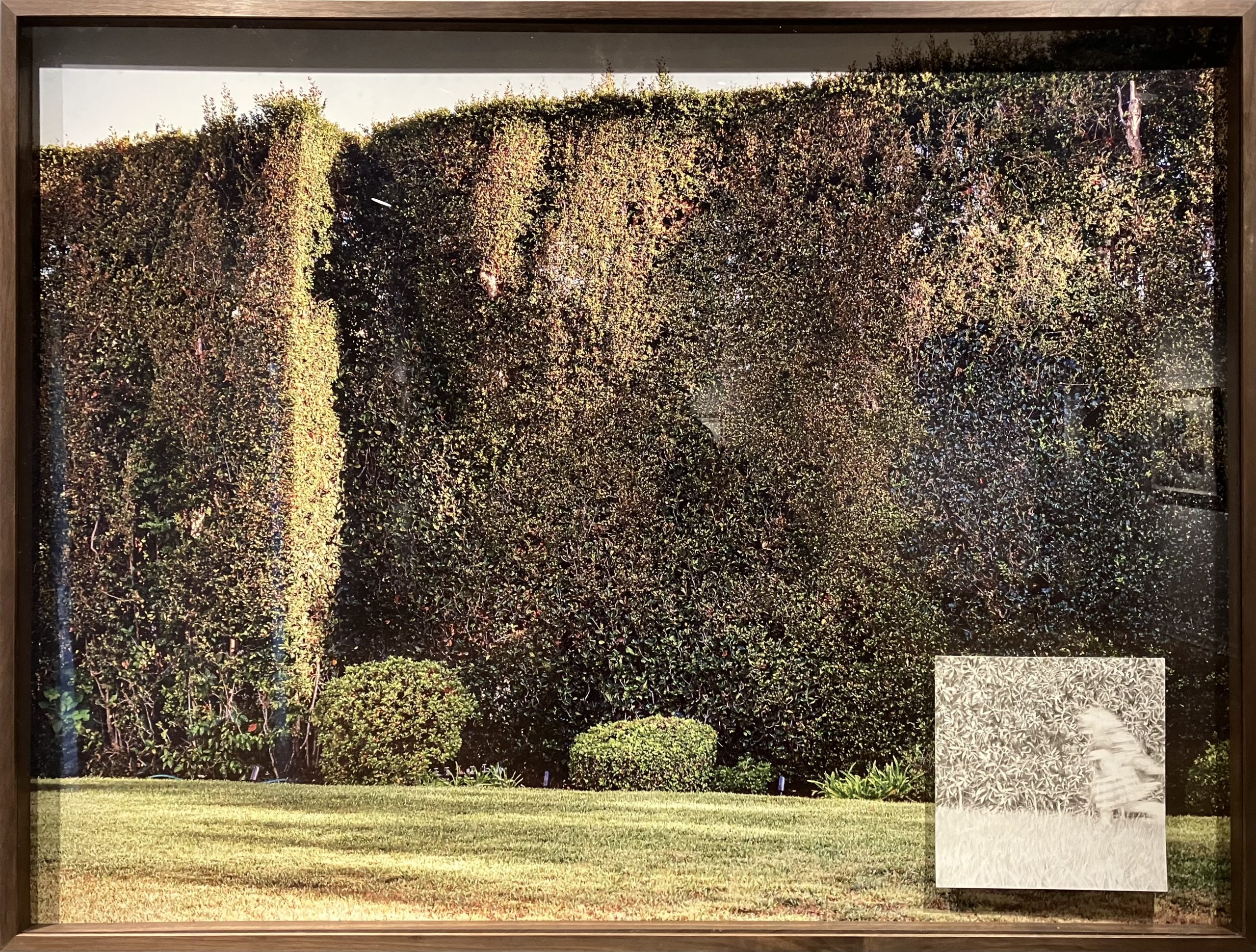
The exhibit begins with a pair of symbolic images that, while rough and convenient, serve to demonstrate the organizing principle of the much better work to follow. One of these images has a frame sketched onto a landscape photograph and the other is a photo of two discarded frames that might have held signs in a public building, but stand here abandoned in lush overgrowth. They presumably represent the three actors responsible for what follows: a mix of small insets on larger studies that each contains one of each medium.
Their titles don’t identify the scenes, but might be read as koans or poetic excerpts: “not as truths . . . but as remnants . . . at rest . . . in passing” could also be “at rest . . . in passing . . . not as truths . . . but as remnants” and so forth, so that they collectively propose a mood while incidentally labeling the ensemble. In fact, language plays a far more substantial part of the Seven Views than it conventionally does. From the statement’s diction, it seems likely that it was written by Maddison Colvin, who amplifies moods and effects that are to be found in the works:
She walks those same tree-lined streets each day, and she recognizes the trees. Looking closely at the flowers and the leaves in the margins of his pictures, she draws them. The pictures form slowly and she travels through time, summoning the past and immersing herself in it completely.
So the drawn landscapes are by Colvin . . .
In the summer of 2026, another photographer adds to the catalog of images. Now he explores these streets, new to him, and photographs the second growth. He checks his peripheries, trying to see a place for what is is around the edges of the Subject. His pictures, for better or worse, leave more evidence than they take.
. . . and the photos are by Talbot.
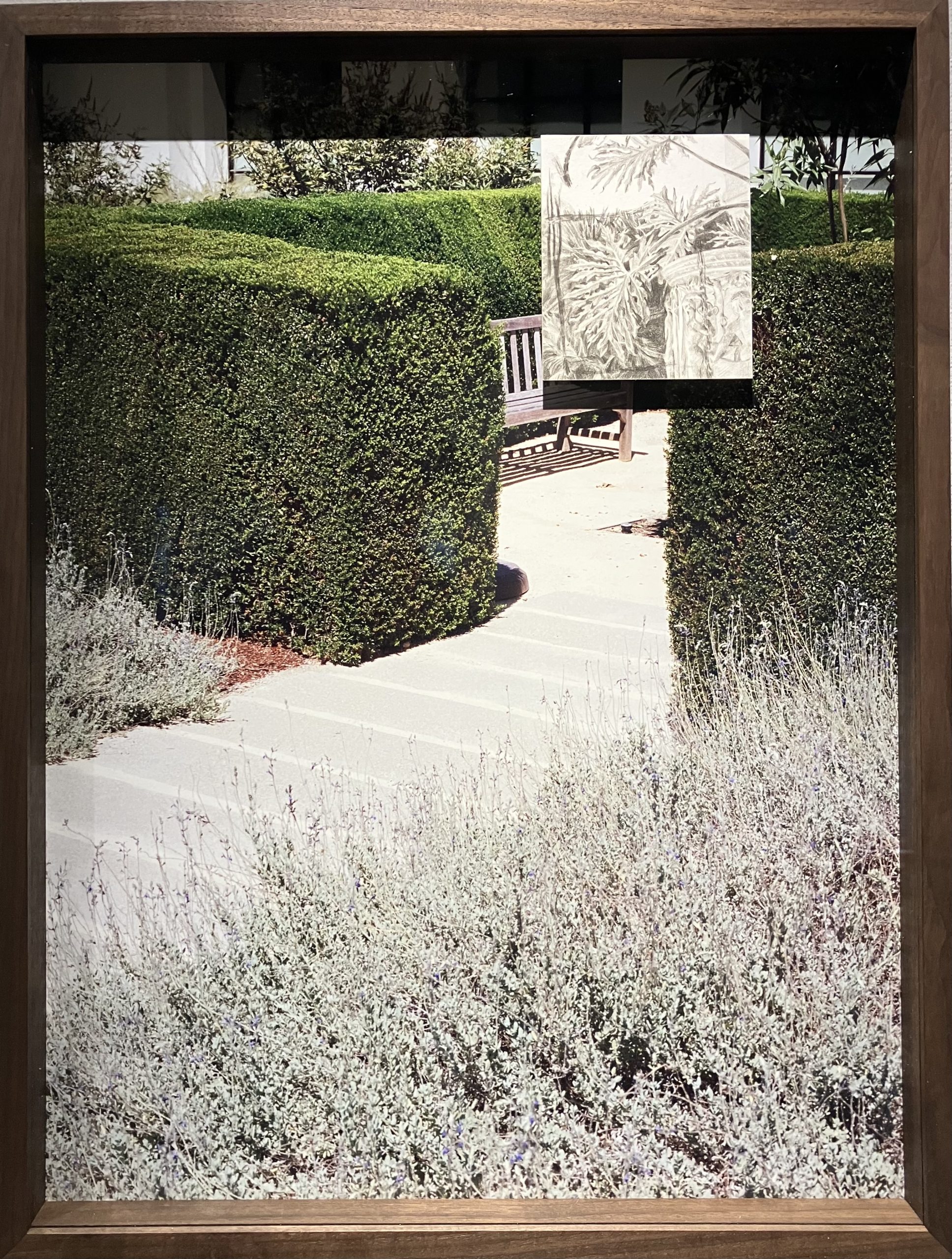 A final observation comes to mind. The show in the gallery next door makes ambitious use of optically complex works in visual layers, which invite motion, exploration, and stopping here or there to take in the layered visuals parallax produces. The space of Seven Views of San Marino is comparatively empty, the art arranged in a single layer, even though each work actually and in itself contains two, and flows along one wall that is faced by a gallery bench. This comparatively empty second space invites contemplation while at rest. In so doing, it further invokes the old world charm seen in nineteenth century gallery portraits, which adds to the effect of evoking the continuity between art in the previous century and the much different work of our time.
Maddison Colvin & James Talbot: Seven Views of San Marino, Finch Lane Gallery, Salt Lake City, through Dec. 18.

Categories: Exhibition Reviews | Visual Arts