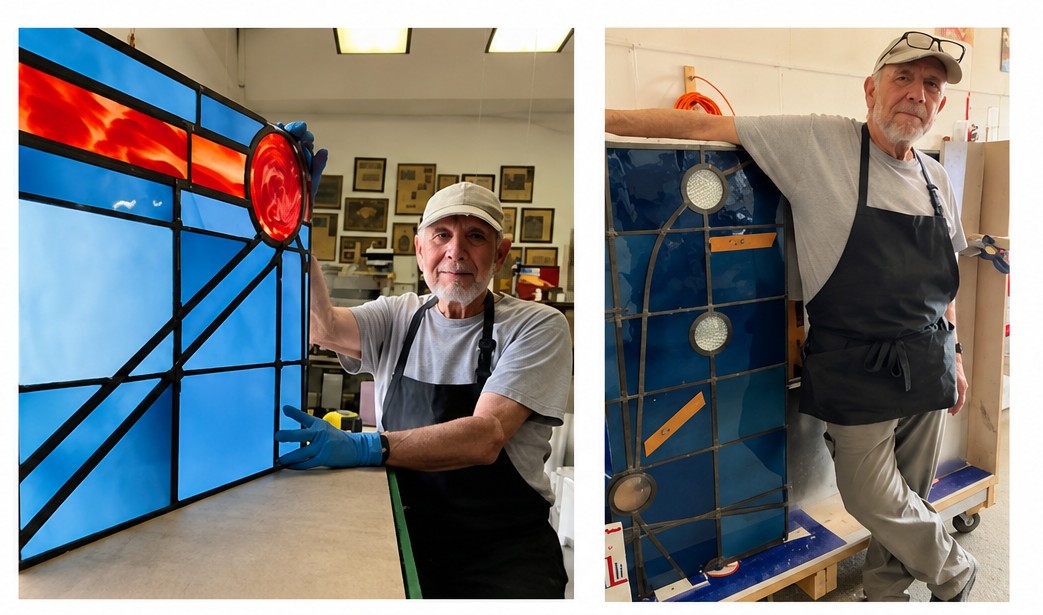
Jenkyn Powell in his Salt Lake City workshop.
When Jenkyn Powell’s monumental stained-glass installation at Salt Lake City International Airport came back from restoration, something was terribly wrong. The 600-square-foot work, originally commissioned in 1995, had once been reinforced by 126 iron support bars. After restoration, just 18 remained, none of which were attached to the glass. The work, Powell concluded, was slowly crumbling. For an artist who had spent six decades mastering the possibilities and peculiarities of glass, the situation presented an extraordinary challenge. Powell would have to bring all 45 panels back to his studio and painstakingly reconstruct a work he had completed thirty years earlier. And just as that project was getting underway, another commission was approaching its deadline: a new stained glass window for St. John’s Episcopal Church in Logan.
For those familiar with the art of Utah native Jenkyn Powell, the phrase “living national treasure” has a particular resonance. Powell, who was born in Utah in the middle of the twentieth century, was then positioned to take full advantage of craft movements that would soon turn materials like wood and glass into recognizable arts. Following in the footsteps of his older brother, James, a musician of national stature whose discovery of glass art transformed his life, Jenkyn eventually became one of the more accomplished and influential glass artists in America.
Most glass artists find it irresistible to avoid settling into a single form of glass art, so after, for example, learning flat, or stained glass, they go on to blow, slump, bend, fuse, carve, kiln cast, or find other, more innovative ways to manipulate it. Jenkyn was no exception: after playing with a box of glass and some tools left in the basement by James, he set out to marry his new medium to his love for pulp fiction in windows that broke with tradition, but perfectly matched the ’60s mood by featuring subjects drawn from the adventure stories he read as a boy.
Eventually, unlike most of his contemporaries, his pursuits led him back to Europe. There he studied at the York and Salisbury Cathedrals with artisans who were restoring stained glass that had suffered from centuries of wear, newly mechanized street traffic, and war. He also followed the lessons James had given him in painting on stained glass, a technique central to its history but not as important over here, by studying with the Lithuanian master Albinus Elskus, the most influential glass painter of our time.
-
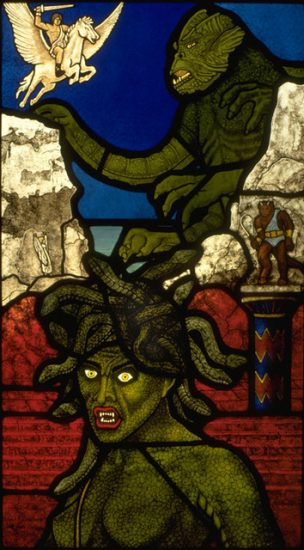
- Jenkyn Powell, “Clash of the Titans”
-

- Jenkyn Powell, “The Seventh Voyage of Sinbad”
In 1967, James and Jenkyn had cemented their family connection by founding Powell Brothers Glass Art, even though James had moved to Los Angeles for his music and Jenkyn stayed in Utah, and they would not always share their commissions or other projects due to the 700 miles that separated them. A decade later, as if to certify that trend, Jenkyn’s a dragon-like sculpture of the Sambhogakaya, a Tibetan Buddhist visualization, was lauded as “one of the most significant works in the glass world” by the staff of Corning Glass, considered by many to be the world’s authority on such matters. That they still saw themselves as collaborators continued even when Jenkyn accepted an invitation in 2009 to become the studio manager at Willet Hauser Architectural Glass, in Philadelphia. Willet is one of the oldest, largest, and perhaps the most prestigious such studio in the United States, with work all across the country. Powell, whose speech even today is peppered with references to “Philly,” rose to become general manager before deciding, in 2014, to return to Utah and again take up his more personal creative endeavors.
Early on, harmony had emerged as the foremost principle in Powell’s stained glass. He notes that even though religion is nowhere near as central to art as it used to be, there is still a lot of architectural glass art being installed, and it is still associated with churches and similar applications. Moreover, a strong association with buildings and public spaces that people share makes demands that impose responsibilities on any artist involved. Despite his personal criticism of so much of the political and social misbehavior of our unfortunate era, Powell believes his work should promote feelings of peace and, unlike so much modern art, not be jarring or stressful. “Life is always better if we can have restoration in our art, and if it creates sanctuary from the storms we encounter daily,” he wrote in an early statement he has never seen fit to repudiate.
To that end, he sees how the qualities of line, color, shape, and form need to merge with architecture and address the space within a building in a positive way, one characterized by its having been well designed. He notes, further, that most of the techniques he employs involve heating glass to change its original characteristics, and he believes that can impart unity to the finished work. These are things that the audience may not notice, but which influence a viewer’s experience. This means he works today from a perspective that was sixty years in the making, and it is compelling to watch the combination of received and conceived ideas that guide him through the challenges that any artist faces while navigating the choices that comprise the making of art.
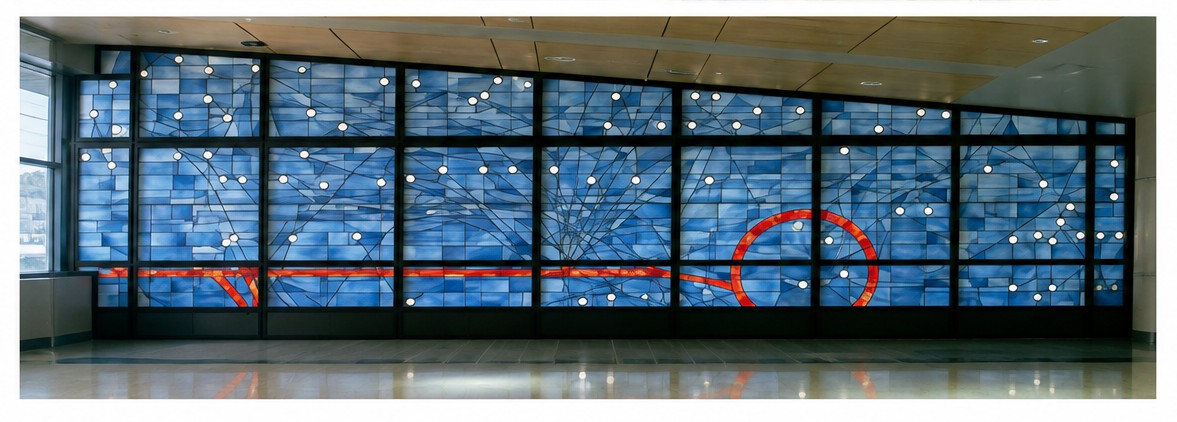
Jenkyn Powell’s original “You Are Here” as it appeared in an upper lobby at the Salt Lake City airport.
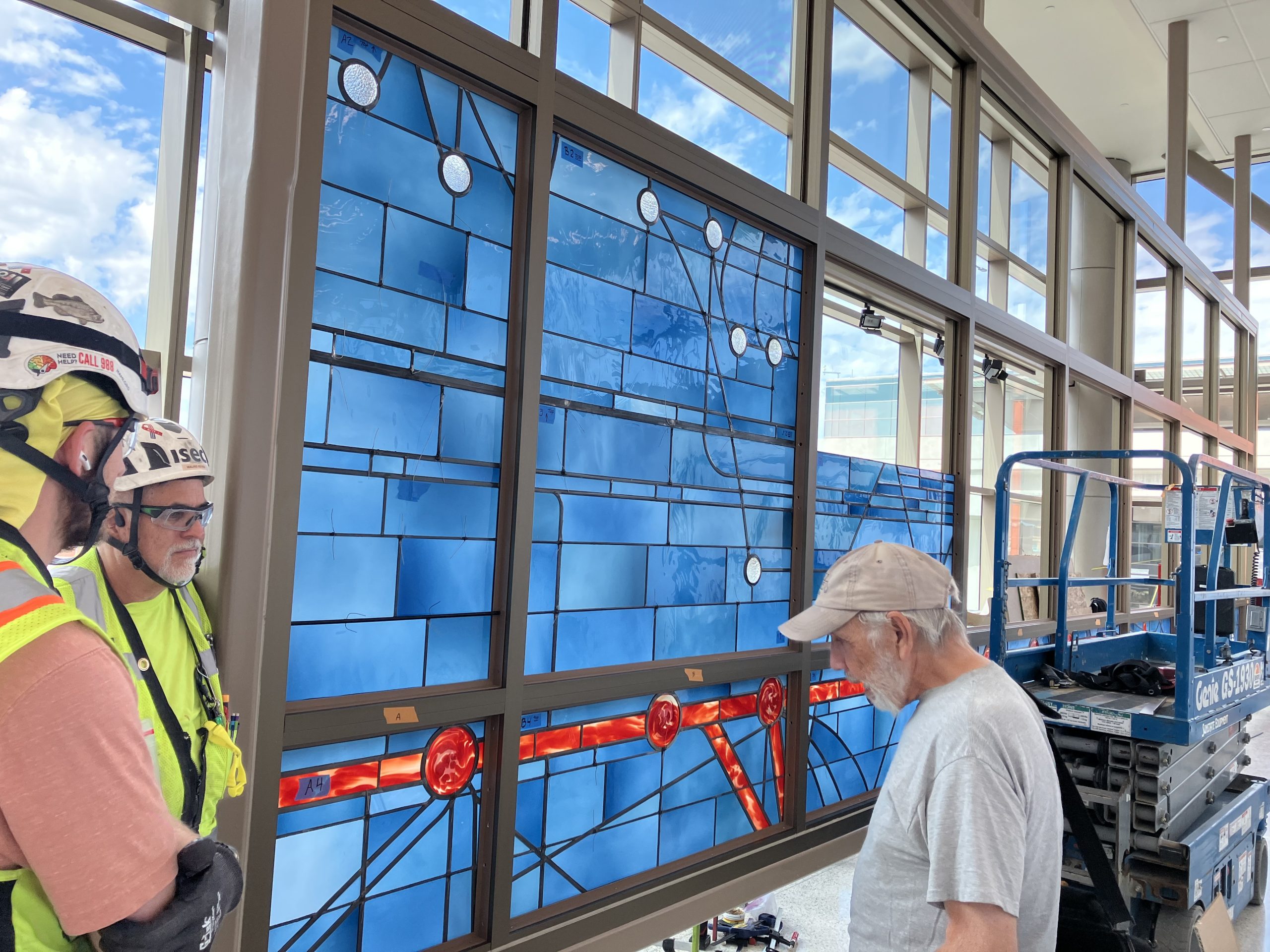
Powell oversees installation of the refurbished and expanded “You Are Here.”
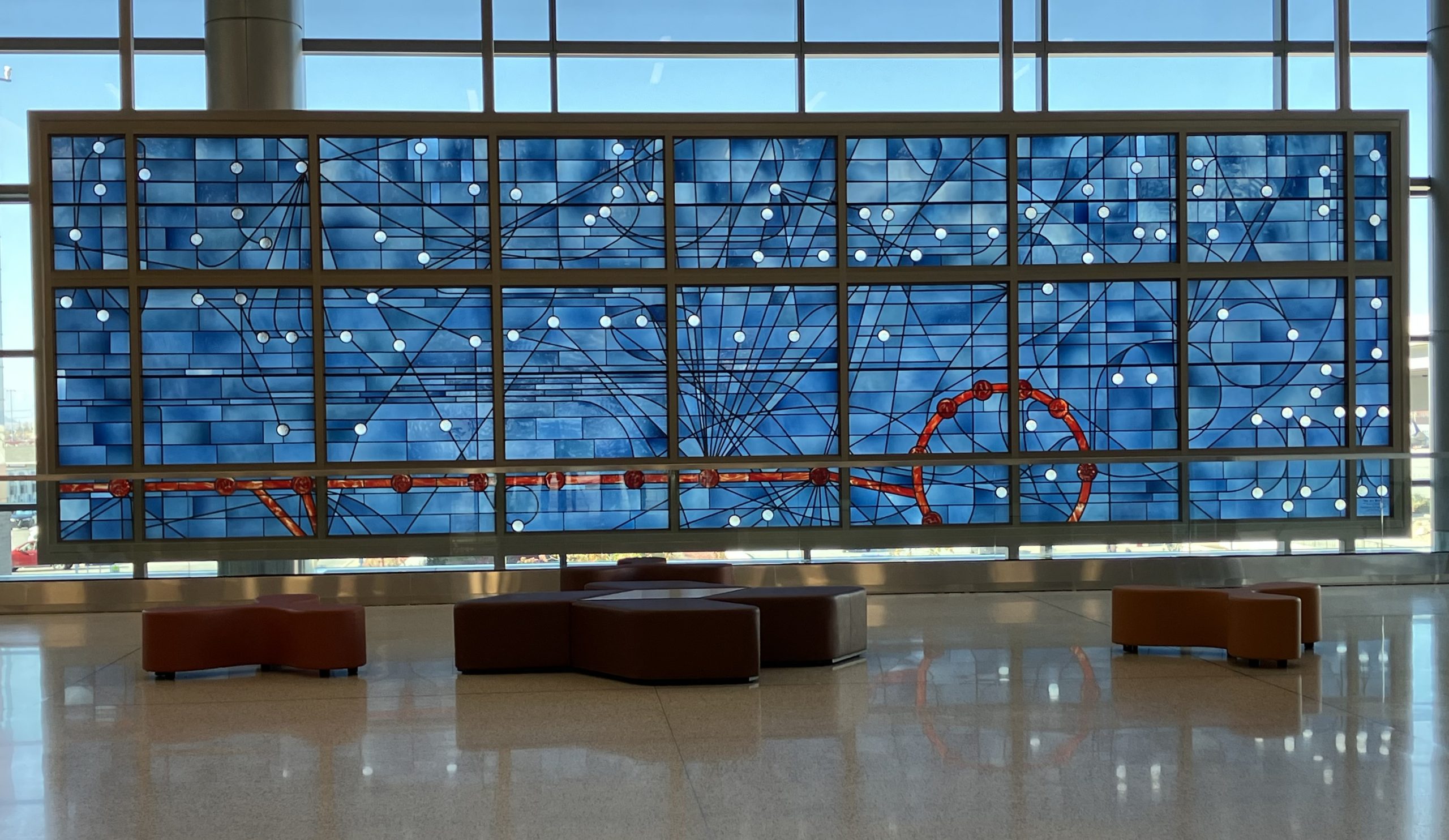
Powell’s “You Are Here” the new Salt Lake City International Airport’s gateway area.
Two long-term projects Powell recently completed illustrate the point. One has been part of his life for thirty years, the other has taken less than a tenth that long, but each preoccupied his time and energy. The first began with a 1995 commission from the Salt Lake City airport for a stained glass partition—essentially a unique room-divider separating international flights and their activities from domestic flights—which required a wall of glass forty feet long and about fifteen feet high. Unfortunately, the governing authorities then chose not to authorize international flights to or from Salt Lake. Consequently, “You Are Here,” a predominantly sky blue, geometric abstraction based on biology—on a sophisticated visual diagram of elaborate bodily processes with names like “the Krebs cycle” and “glycolysis”—was not allowed to become the central feature of arrival and departure it was meant to be.
Of course, an airport is neither a calm nor a stable environment. Travelers in a hurry collided with the glass wall and broke it. International flights were authorized, only to contribute to growth that eventually required replacing the entire building: a huge project that challenged everyone involved. Powell’s glass was sent out for repairs, but satisfied no one on its return. Most unsatisfied was the artist, who noted that thirty years before, it had 126 iron bars that supported its 600-square feet of fragile glass and malleable lead, but only 18 (!) of those bars remained, and they were no longer attached to the window.
Powell took his concerns for the future of his artwork—but more importantly for the safety of the public— to the airport’s authorities, and they asked for a comprehensive report on what was needed. Between the old damage done by the public and the shocking new damage done by unqualified restoration, he found it was literally crumbling in slow motion, and required nothing less than removing the entire work to his studio and meticulously reworking each of the 45 panels that together comprise it.
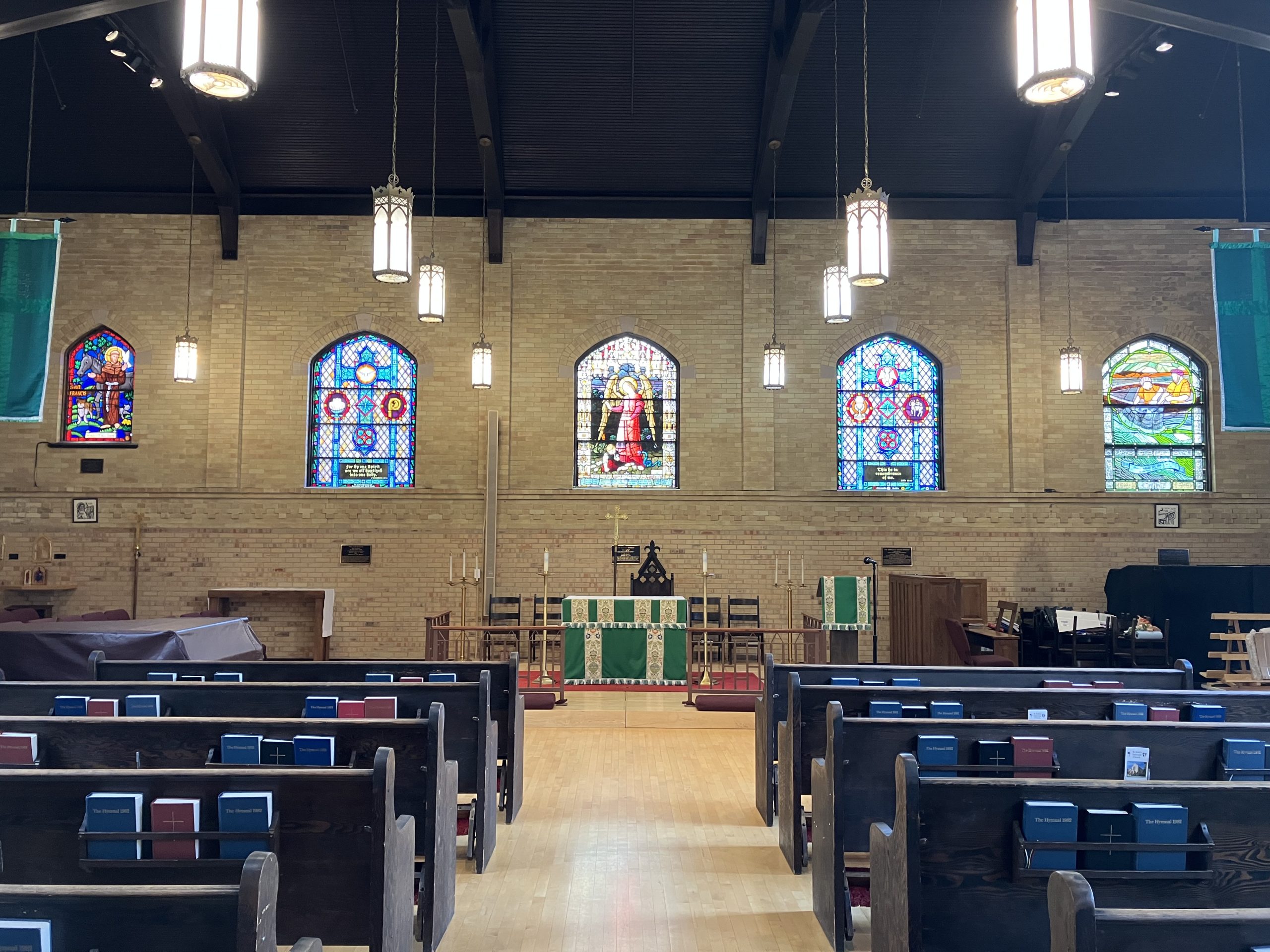
Stained glass at St. John’s Episcopal Church in Logan.
Complicating the challenge, during this time a completely separate project, to design and build in a timely manner a memorial window for a church in Logan, reached the point where it would coincide with this emergency and also require space in the studio.
St. John’s Episcopal Church is an average-sized congregation with an extraordinary collection of stained glass windows. The largest is by Charles Connick, whose church windows rank alongside the mostly secular work of his near-contemporary, Louis Comfort Tiffany. The window Powell created for St. John’s is on a traditional subject, but his skill enabled him to give it a contemporary twist. Depicting Jesus in his familiar role as shepherd, Powell placed him among a herd of sheep that in their placement, postures, and even their colors play symbolic roles that, while subtle, convey parallels between the animals and those persons in the church who see them. Some in the distance ignore their shepherd and concentrate on their grazing. These are slightly darker, as befits the aerial perspective of distance. Closer up, some sheep respond to the man’s presence, one going so far as to allow itself to be placed across his shoulders. The fleece of the sheep in the foreground is progressively lighter and finally brighter, though the sermon, so to speak, is modestly presented as befits a willing and sophisticated modern audience.
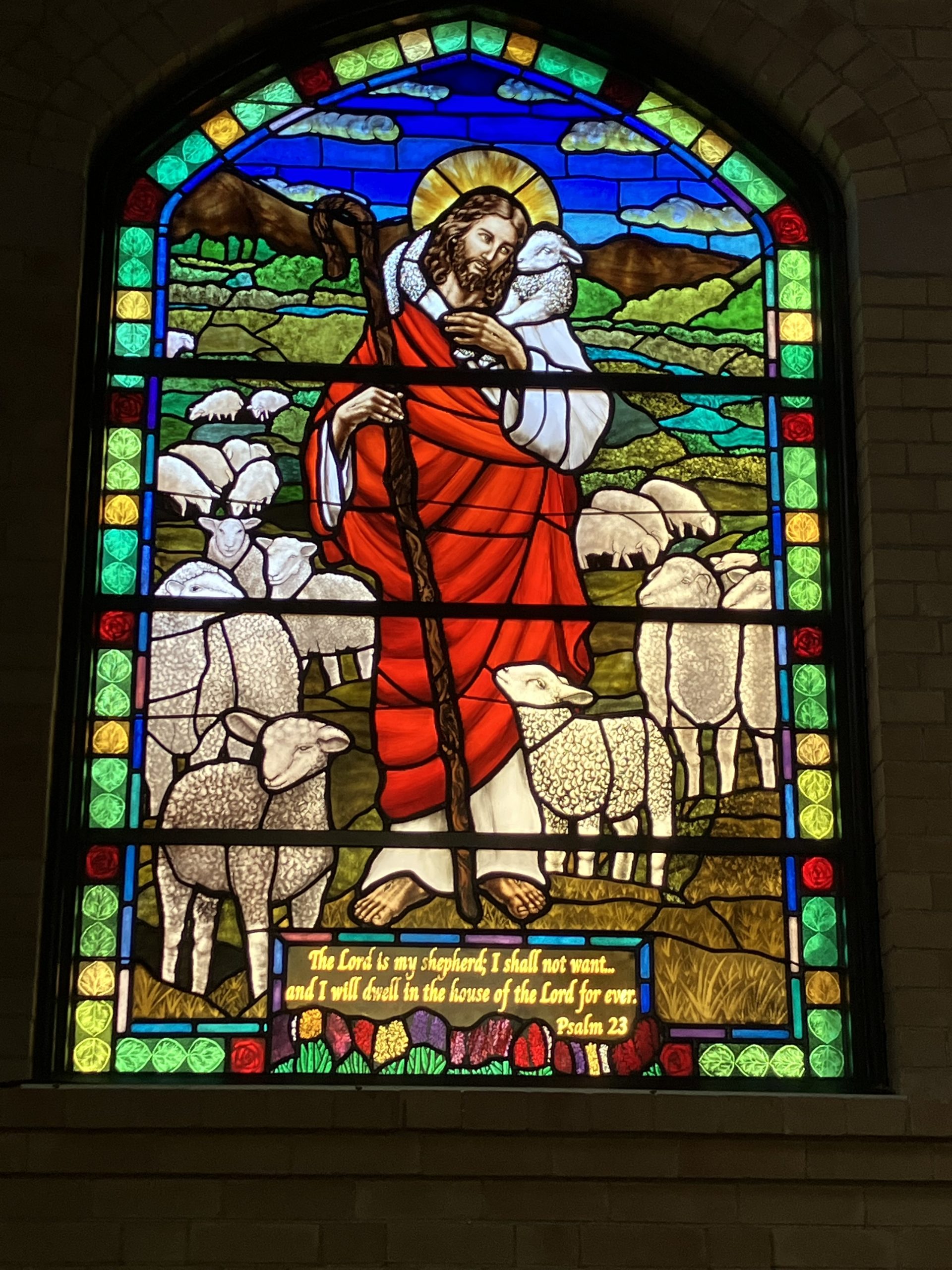
Jenkyn Powell’s “The Good Shepherd” St. John’s Episcopal Church
And so, after a combined total of 33 years, his two separate, unconnected projects ended up being installed in the space of a single week. Only the experience gained from literally dozens of commissions and personal works made over sixty years, some small and some dauntingly large, each in its own way unique, could have prepared an artist to take on two such contrasting and challenging works at the same time. And as the spacious and handsome new Salt Lake City International Airport assumes its essential place in local life, and St. John’s Episcopal worshipers open their hearts and minds to a new window, Jenkyn Powell will quietly return to what has become his life’s work.

Categories: Artist Profiles | Featured | Visual Arts