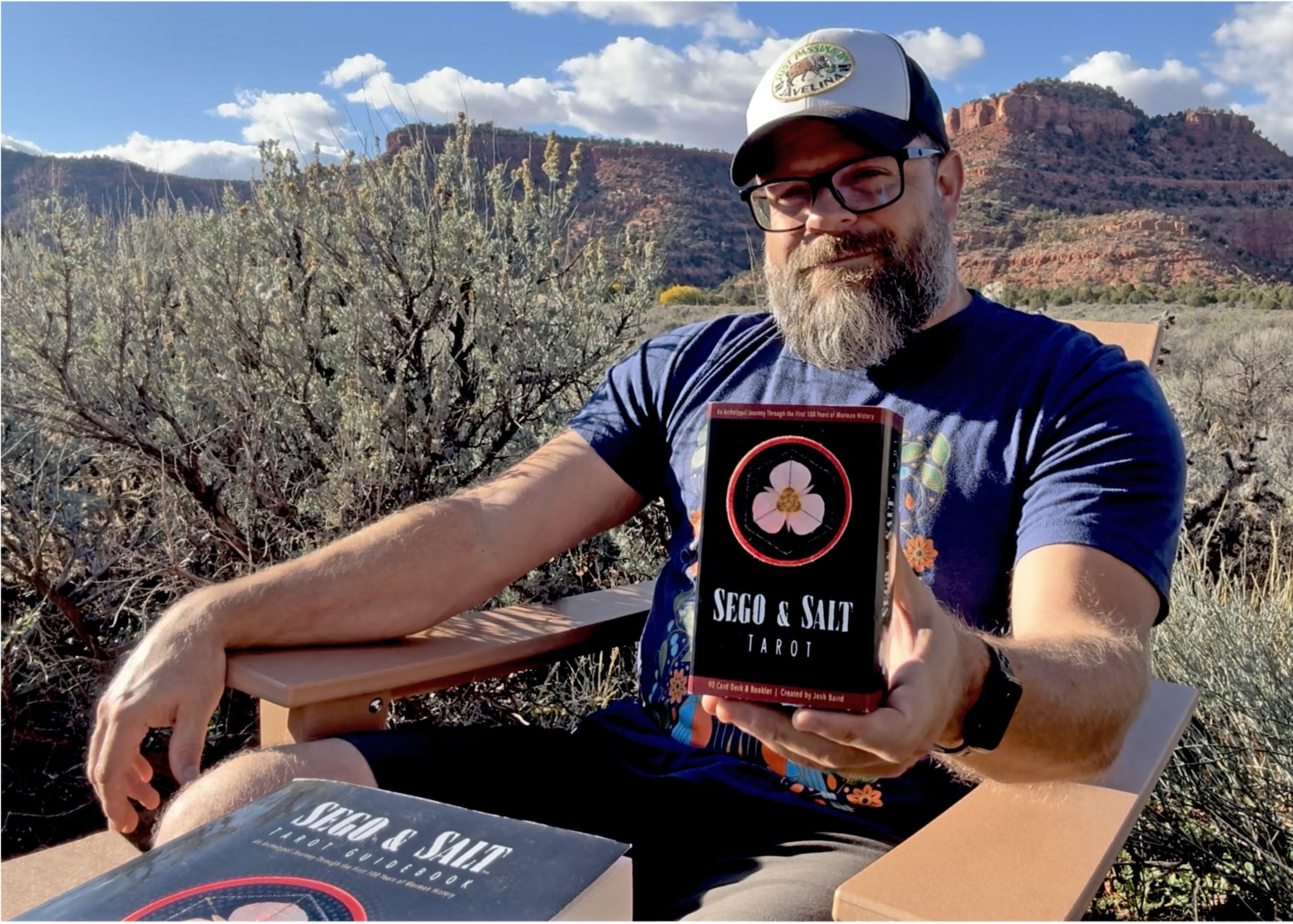
Artist Josh Baird holds his Sego & Salt Tarot, a 90-card deck that reinterprets the first century of Mormon history through the symbolism of tarot.
Porter Rockwell, the notorious Mormon gunfighter, makes a convincing Death. The destruction of the Nauvoo Temple fits naturally into the Tower, a card associated with catastrophe and the collapse of established structures. And Joseph Smith, the young visionary, seems almost made for the Fool.
Once Joshua Baird started seeing the parallels, it was hard to stop.
It began with a chance purchase of two tarot decks in a Seattle apothecary in 2009. It became Sego & Salt, Baird’s ambitious illustrated history of early Mormonism told through the imagery of the tarot—a project that comprises 90 cards, a 720-page companion book and more than a decade of research, drawing and revision.
Curious about the imagery of those first two decks he bought on a whim, Baird soon acquired the influential Rider–Waite–Smith deck and a beginner’s guidebook. He had studied postmodern art at Southern Oregon University, and the possibilities of adapting an established visual system were immediately apparent. “Within the first half hour of reading the guidebook I had laid out parallel concepts to early Mormonism for most of the cards,” he recalls. “Certain cards like The Tower, The Magi, The Fool were virtually begging to be adapted to a Mormon context. Some of the parallels were so perfect it was almost eerie when they popped in my head.”
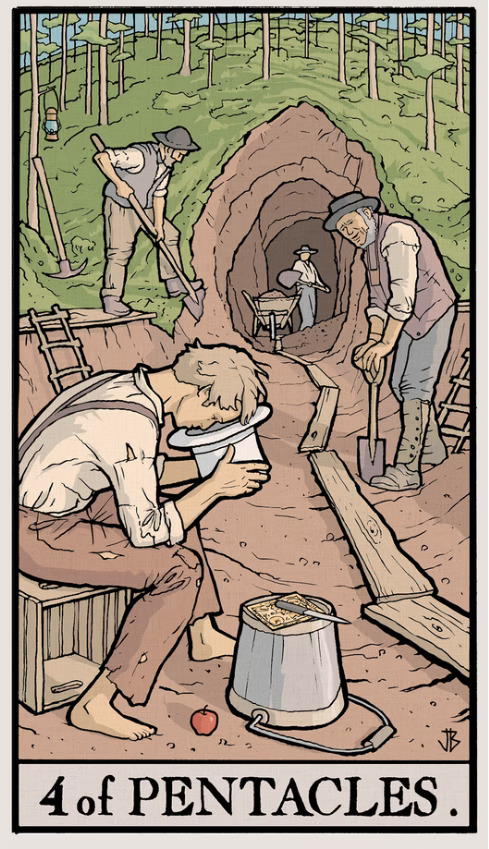 Baird, whose Mormon ancestry stretches back nine generations on his father’s side and seven on his mother’s, had no interest in adding to the stock of devotional illustrations celebrating Mormon pioneers and prophets. The tarot’s archetypes include villains, catastrophes and betrayals alongside heroes and revelations, and you have to make room for all of them. “You can’t just cut out the devil, the tower, death, the 10 of swords,” Baird says.
Baird, who lives in Kanab, in redrock country at the southern edge of the state, is primarily a landscape painter. “I knew nothing about tarot, or illustration, or the printing industry,” he says. “I also wasn’t very familiar with drawing narrative compositions containing multiple figures; but my primary motivation has always been learning, and I love a good challenge.”
For several years the project was more conceptual than actual. By 2017, Baird had settled on an approach. He submitted several cards to the Springville Museum of Art’s Spiritual & Religious Art of Utah exhibition. They received an honorable mention. More consequential was the reaction of museum director Rita Wright. She had studied tarot during her doctoral work, and later told Baird she had spent about 45 minutes talking with her docents about the piece. “After the show she pulled me aside and enthusiastically asked if I was going to do a full set of cards,” Baird recalls. “The idea of doing a full set was so incredibly overwhelming I didn’t know how to respond, but if it weren’t for that interaction, I’m not sure I would have done the whole set.”
He established a Patreon account, which gained more than 80 supporters, and began producing two cards a month along with research material. The illustrations were completed in 2023, followed by another two years of preparation for printing.
Visually, Baird’s deck reliew\s on the compositional language established by Pamela Colman Smith. Her illustrations for the 1909 Rider–Waite–Smith tarot have become among the most recognizable images in the history of the medium: heavy black outlines, flat areas of color and relatively simple arrangements of figures. Smith’s work has been “the gold standard for the last century,” Baird says, and her deck is in the public domain, which made it easier to work with in the book. It gives Baird’s deck a visual consistency, even as their subjects range across a century of Mormon history. His initial designs were more heavily stylized, but he discovered that historical storytelling imposed its own demands. “They couldn’t get too far from a naturalistic representation, because the likenesses of the people needed to be as clear as possible.”
Rockwell, known as the “Destroying Angel” of Mormonism, is one of many dark figures in the deck. The history of Mormonism and Freemasonry provided material for another card, researched with assistance from historian Cheryl Bruno, who wrote a book on the subject with Nick Literski. Helen Mar Kimball, who was married to Joseph Smith at age 14, appears in the Two of Swords. “I tried to illustrate important scenes that had never been depicted before,” he says. “Those cards were in many ways the most fun to research.”
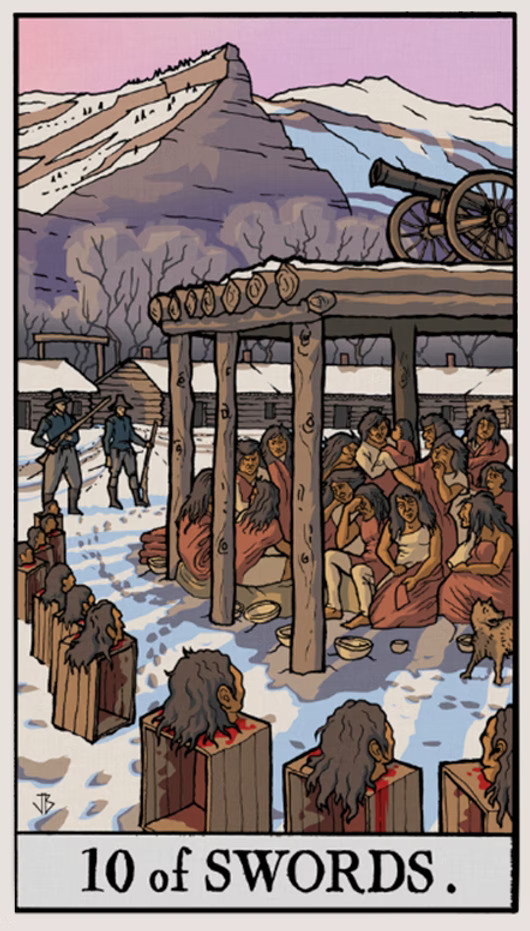 For the Mountain Meadows Massacre, Baird chose two separate cards. The Seven of Swords depicts John D. Lee’s deception, while the Eight of Swords focuses on the surviving children in the aftermath. He gave the Ten of Swords, the deck’s card of ruin, to the Timpanogos rather than to Mountain Meadows partly because of the irony—in 1850 LDS church leaders ordered the Timpanogos exterminated, only a dozen years after Missouri’s governor had issued an extermination order against the Mormons themselves. “The irony is Shakespearean level,” Baird says.
Mormon visual culture has traditionally been shaped by religious institutions and artists working within a devotional framework. “So much of the visual culture surrounding mormonism is biased, and I felt like the comprehensive nature of the tarot would create a space that would be free of the conventional belief motivated aesthetic,” he says. “I didn’t want to promote belief, I just wanted to tell the story according to the best scholarly information I could find.”
Baird also found the traditional tarot insufficient for everything he wanted to include. He now owns more than 100 tarot decks, including many that predate Rider–Waite–Smith, and they taught him “there’s all kinds of room for flexibility in the tarot.” He expanded the court cards from four to six per suit, introducing additional male and female counterparts. “I added extra court cards to include more of the incredible women I had come across in my research,” he says. “There’s something very Mormon about having three levels of court cards each with a male and female counterpart.”
He also created three versions of the Magician, an idea he traces to the Choose Your Own Adventure books of his childhood. Moroni, the angel who appeared to Joseph Smith, represents the believer or apologist. Luman Walters, a folk magician associated with Joseph Smith and the early Mormon movement, represents the believing empiricist: historians like D. Michael Quinn and Juanita Brooks. A card called the Architect of Belief stands for the naturalistic interpretation of historians such as Dan Vogel and Fawn Brodie, whose biography of Joseph Smith challenged orthodox interpretations of the church’s founding prophet. “The magicians are my way of welcoming the big tent of Mormonism to this project,” Baird says. “And in a way, it’s also a gesture of respect for the diversity of beliefs and views concerning the tradition.”
The deck ends with two World cards, which Baird calls the “reflectionary” counterparts to the visionary Fool of Joseph Smith. Each incorporates a mirror: one a reflecting pond, the other a full-length mirror.
The first features a young girl inspired by the Equal Rights Amendment and Ordain Women movements, and by the Fearless Girl statue installed facing Wall Street’s Charging Bull. Officially, she is anonymous. “She could be anybody: Sonia Johnson, Kate Kelly, Fawn Brodie…” Baird says. “For me the little girl is Fawn Brodie.” He sees something of the Fool in her too: a future-oriented card that “addresses modern challenges like correlation, big money, and feminism.”
The other depicts historian Juanita Brooks, whose groundbreaking research on the Mountain Meadows Massacre helped bring one of Mormonism’s darkest episodes into public view. Baird drew inspiration from a scene in Brooks’ memoir Quicksand and Cactus, in which the young Juanita encounters her reflection in a full-length mirror. The episode had stayed with him since he read the book as a teenager. The mirror itself survives, in the back of the old Dixie Drug, where Baird went looking for it and found it.
“The idea of Juanita seeing the whole of herself is such a beautiful little vignette and microcosm to the subjects she would later take on as a historian,” he says. “As a teen she ran away from the horrors she saw in the mirror, but she would later go directly to the heart of the uncomfortable truths she confronted in her research on Mountain Meadows.”
“Juanita and Fawn were both women who saw the whole of Mormonism, warts and all,” Baird says. “That’s what this entire project is about.”
The project was called The Mormon Tarot—a URL Baird had owned since 2012—until shortly before publication. Then, the week his 750 decks were due to arrive from China, John Dehlin, host of the Mormon Stories podcast, was sued for trademark and copyright violations. An attorney advised Baird to avoid the term “Mormon.” Baird also wanted to make the project’s independence from the institutional church clear, and he knew that Mormonism, “the full wake of Joseph Smith,” is “way bigger than what I had portrayed.”
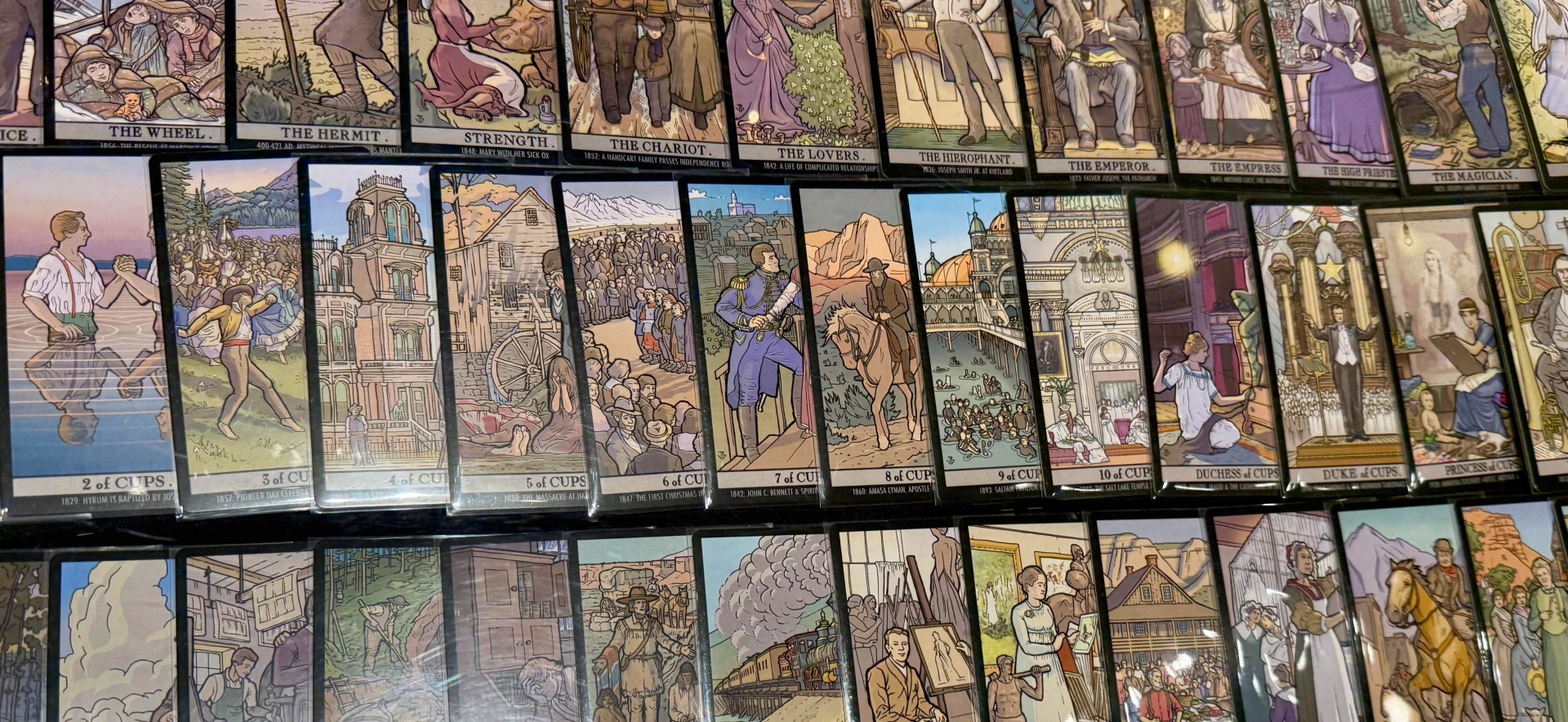
The new title captures the contrasting qualities of the history he was illustrating. The sego lily grows in the foothills and mountains, while salt accumulates in the lowest desert valleys. Together, Baird says, they suggest “light and shade; highlights and lowlights; the good and the bad; the beautiful and ugly, which is what this project is all about.”
Buyers include practicing Latter-day Saints, former members, historians, tarot collectors who know nothing about Mormonism and people from the Sunstone and Mormon History Association communities. Orders have come from Austria and Australia, and the deck has fans among the FLDS, the Community of Christ, Reform Mormons and a group of Freemasons. More conservative buyers tend to be wary at first, but “most of them come around after a brief conversation about Star Wars, the hero’s journey and the importance of archetypes in a well told story,” Baird says. “Curiosity is the common trait among them which makes them all immediate friends.”
The cards are on display at the Springville Museum of Art along with the companion book, which Baird persuaded the museum was as important as the deck. “I think of the cards as my sword, and the book as my shield,” he says. The book’s 720 pages hold his research, sources and citations. A solo exhibition at The Outer Veil in Provo spreads the cards out so they’re easier to look at. Baird has also developed a related project, Sego & Salt Runes, which revives the nineteenth-century Deseret Alphabet by assigning a concept to each character, the way the Elder Futhark runes are read. He redesigned the alphabet’s typography and published a zine to go with it.
After so many years of drawing and researching Mormon history, he’s going back to landscape painting and hopes to supply his galleries with new work. “I actually really miss the smell of paint!” he says. He and his wife Tara are also working on a series of zines of poetry, prose and art about life in and around Kanab.
Baird calls his own views of his heritage complicated.”I find that this collection of people and events gives me something to hold onto that helps me feel close to my past, even though I might disagree with aspects of it,” he says. “The humanity of it all is sublime.”
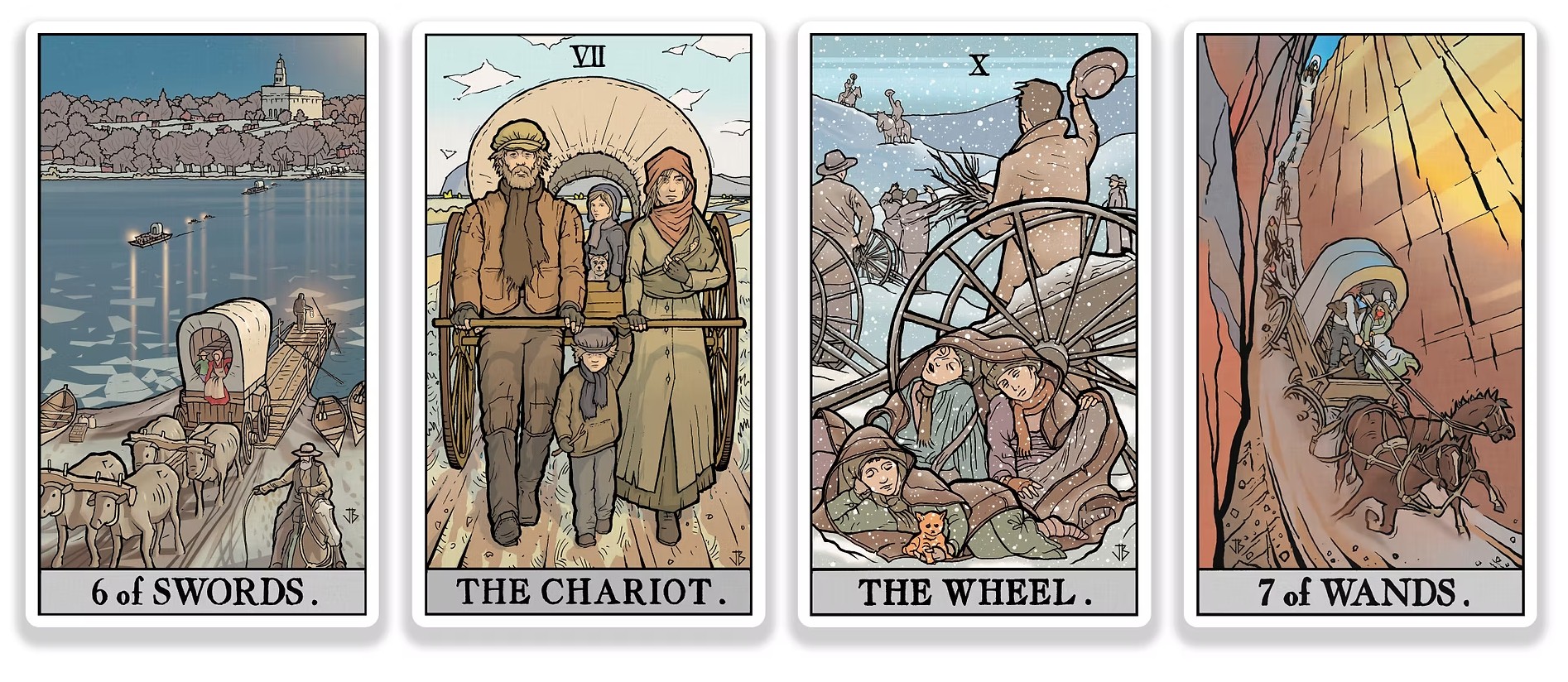
Baird’s Tarot cards depicting the Mormon exodus.
Sego & Salt, The Outer Veil, Provo, through December.

The founder of Artists of Utah and editor of its online magazine, 15 Bytes, Shawn Rossiter has undergraduate degrees in English, French and Italian Literature and studied Comparative Literature in graduate school before pursuing a career in art.
Categories: Artist Profiles | Featured | Visual Arts