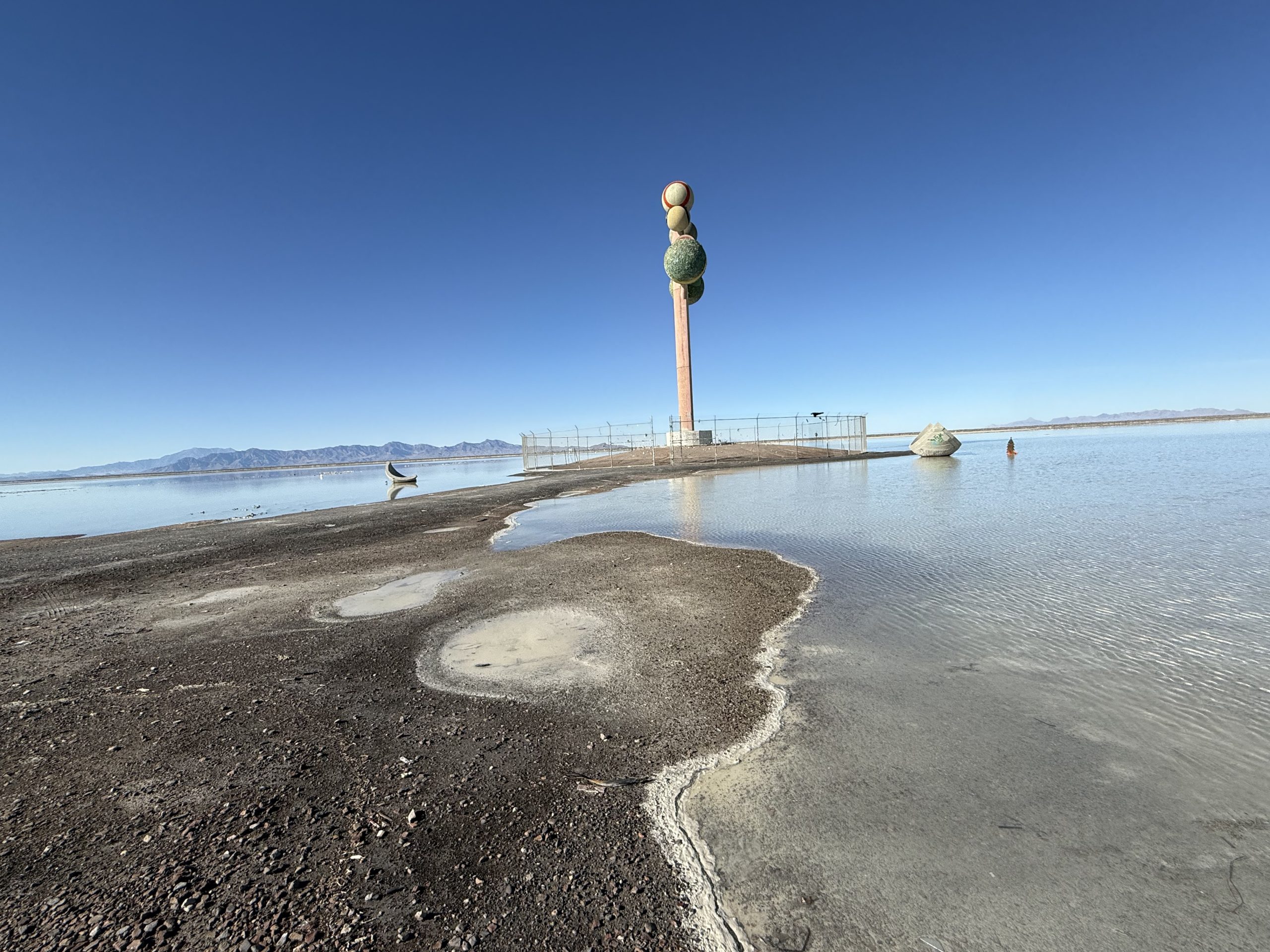
The angel of craziness found Karl Momen east of Wendover and told him to plant a tree.
It was August 1981, and the Iranian-born artist and architect was crossing Utah’s west desert along I-80 when the immense expanse of salt and sky caught his attention. He would later call it “the largest canvas I’ve ever seen.” He looked across the emptiness, and thought “somebody could put something here to break the monotony and put some color here. Why not me?” Years later, he remembered the moment more poetically. “Over this, there was the angel of craziness,” he told The Salt Lake Tribune in 2017, “who immediately sent a signal to me, ‘You should make something here.’”
Trained in architecture in Germany and established as an artist in Sweden, Momen had already developed much of the visual language that would appear beside I-80. When his paintings were exhibited at the Springville Museum of Art in 1985, while his “Metaphor: The Tree of Utah” was still under construction, a Salt Lake Tribune critic noted their geometric structures, horizon lines, bright colors and planetary forms. The Tree became a grandiose version of this vocabulary.
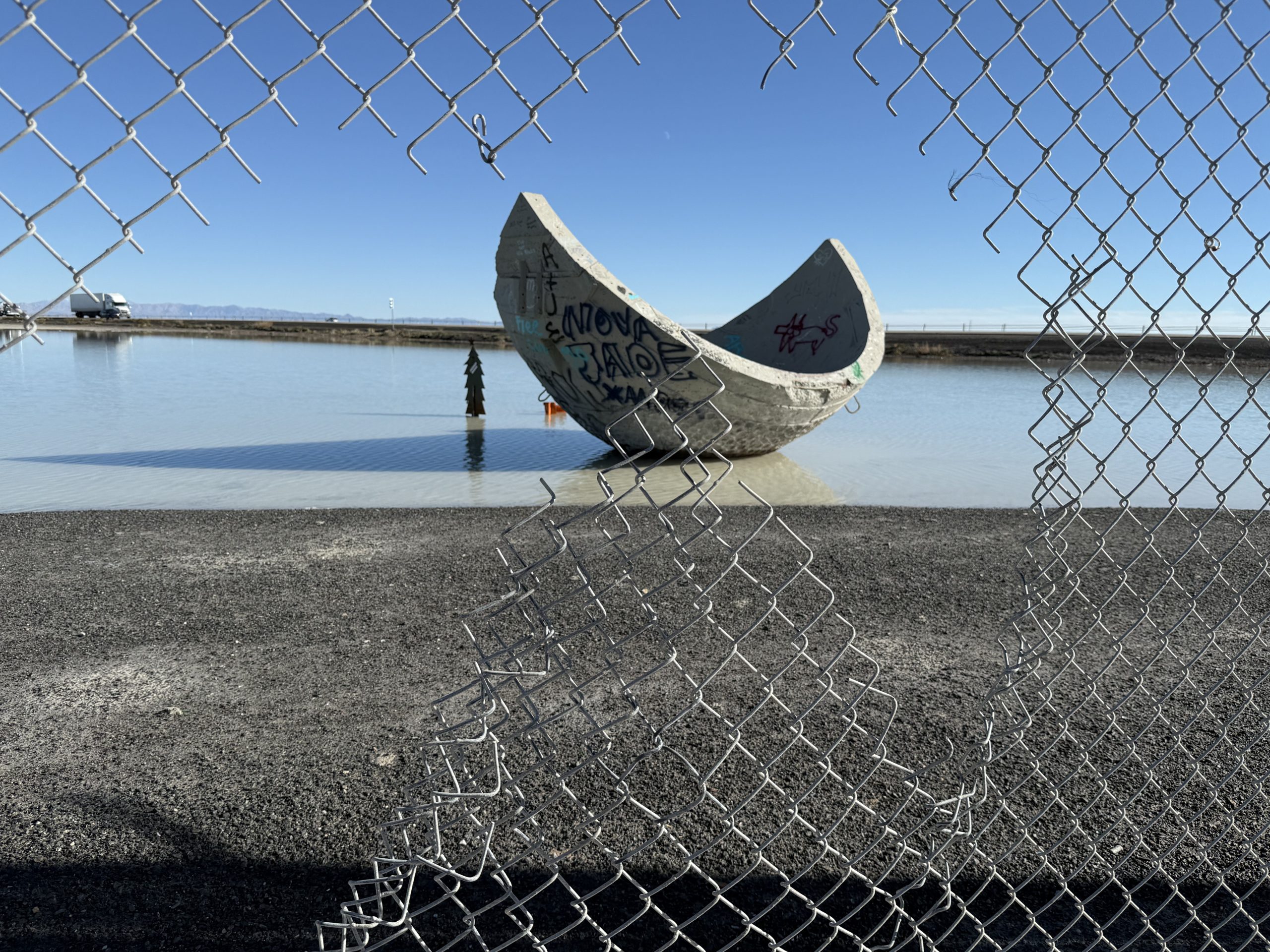
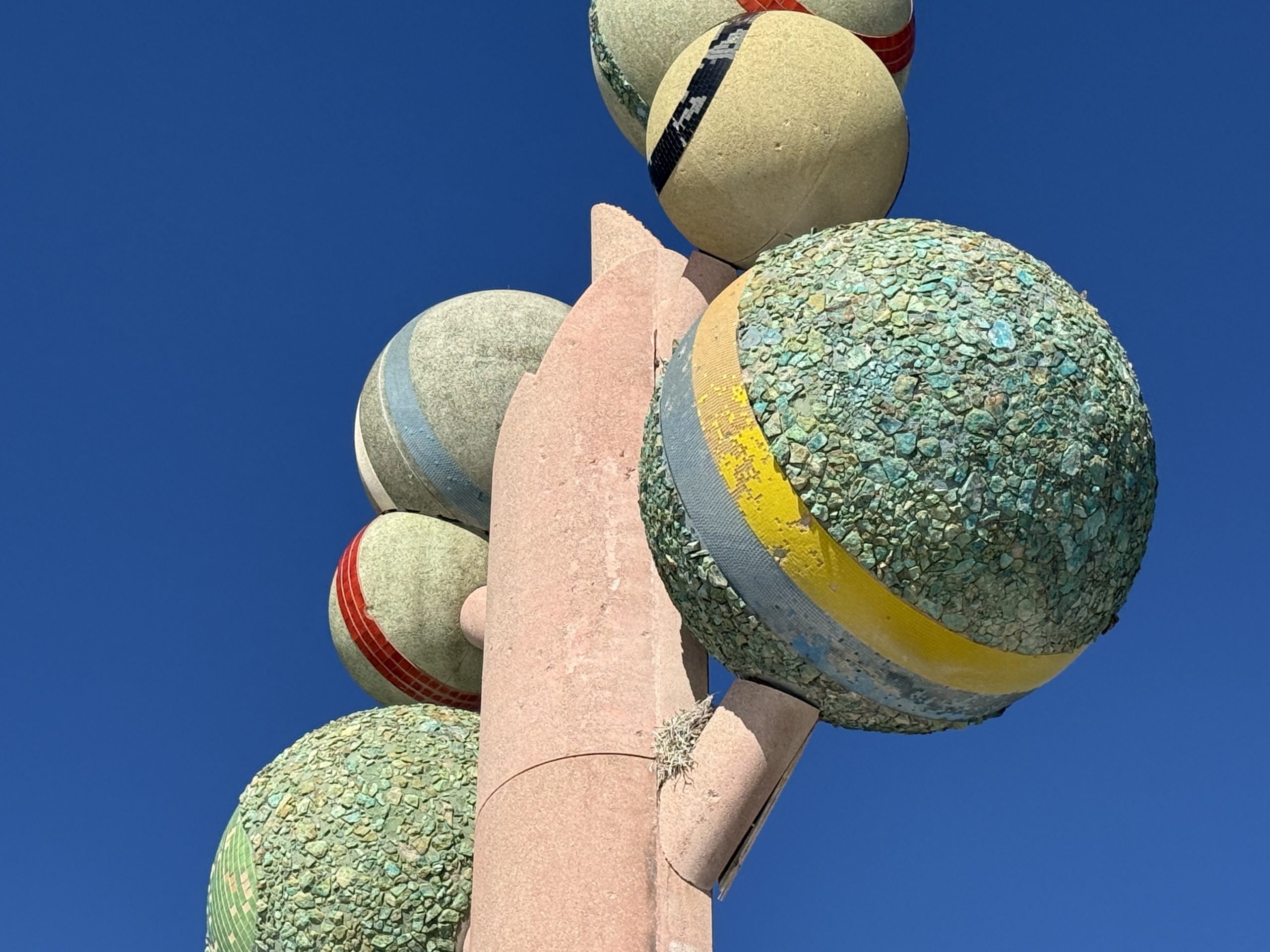
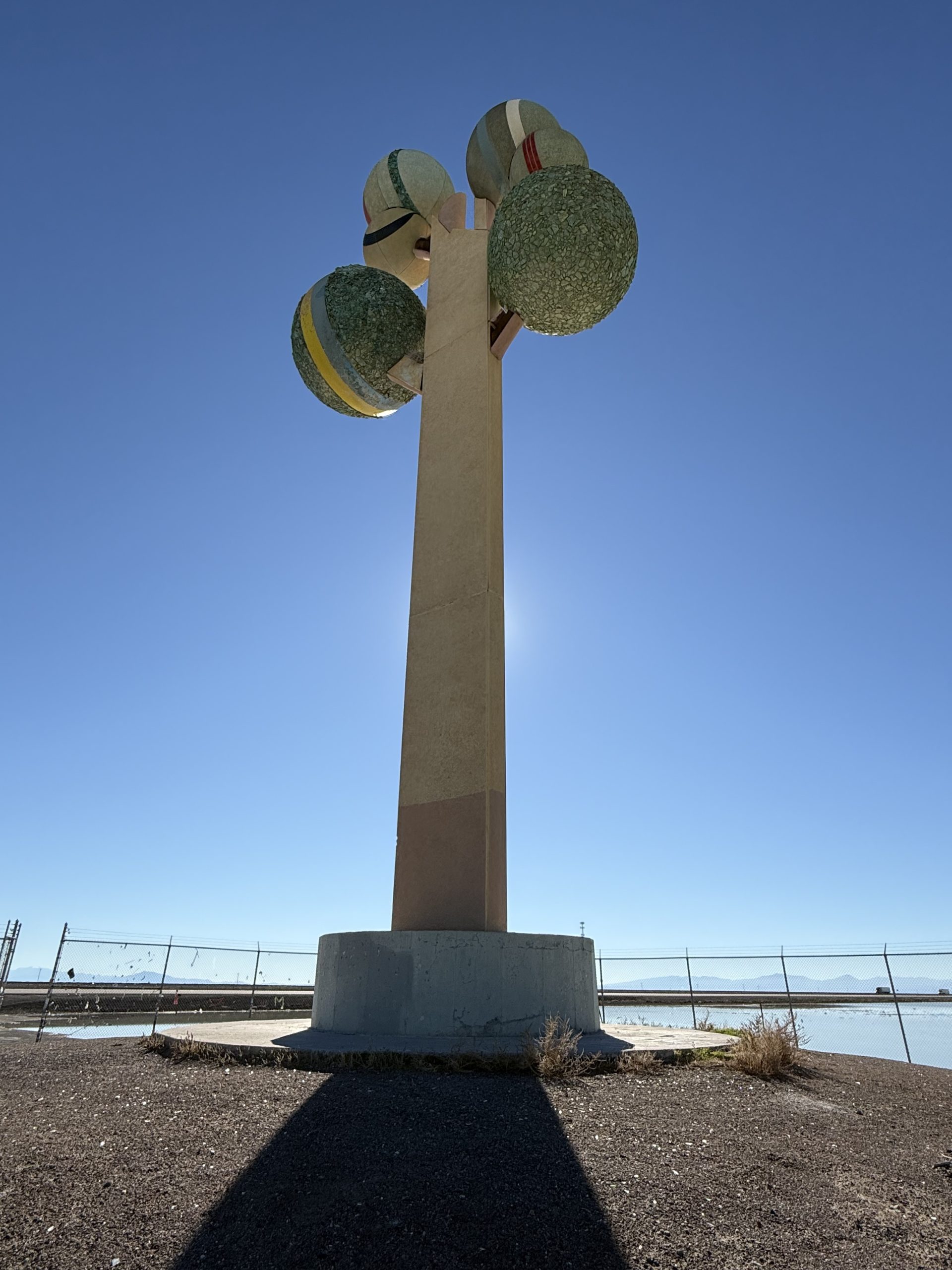 All this might be easy to miss at 80-plus miles per hour. Up close, or in Momen’s own explanations, the familiar “balls” hanging from the Tree become something more. They are fruit, but also celestial bodies, part of Momen’s fascination with the planets. The largest, a turquoise sphere encircled by bands, represents Saturn, his favorite planet. The color, too, is symbolic. On one side of the trunk Momen placed darker colors associated with urbanism and mechanization; on the other, lighter colors invoke the opposing forces of good and evil. He also worked the colors of the Swedish and American flags into the composition, joining his adopted home to the country in which the Tree had taken root. Utah rocks and minerals embedded in the spheres tie this little cosmos back to the ground beneath it. Even the hollow, broken spherical forms scattered at the Tree’s base have a purpose: Momen placed them there to broaden the viewer’s field of vision, drawing the eye away from the trunk and back across the surrounding desert. The Tree was meant to be read both vertically and horizontally, from earth to planets and back into the landscape. Momen described the whole as bringing together “space, nature, myth and technology.” At the 1986 dedication, he called it a “hymn to our universe.”
The Tree weighs about 875 tons. Its foundation is eight feet of concrete, supported by 25 steel-encased concrete piles driven roughly 90 feet into the ground. The largest sphere is 13½ feet across and weighs about 60 tons. Construction consumed some 160 tons of steel, 18,000 imported ceramic tiles and an estimated 21,000 hours of labor. Much of the practical work fell to Utah contractor Don Ryman and his six sons, who had to devise ways to cast and suspend enormous concrete spheres in a landscape of wind, salt and shallow groundwater. Momen paid for the project himself, eventually putting more than $1 million into it.
A February 1985 Daily Utah Chronicle editorial greeted the project with the headline “Steel tree brings touch of absurdity to barren desert.” Momen knew what he was getting into. “Some people are going to say it was a crazy man who did that,” he said while the Tree was being built. “I’m a little bit crazy.”
On Jan. 18, 1986, about a thousand people came to the desert for the Tree’s dedication. Gov. Norm Bangerter pronounced himself impressed. Others were less certain. Salt Lake City artist Don Baxter objected to the man-made intrusion into the purity of the desert. One observer quipped that it looked more like a cactus than a tree. Momen was confident time would work in his favor. “There will be people who will be critical of the ‘Tree,’” he acknowledged. “Nothing has yet been created which pleased everyone.” Then he made a prediction particularly suited to an anniversary: “I am very sorry for those people who do not like it, but I am sure their grandchildren will like it.”
When Momen offered the sculpture to the state that October, The Salt Lake Tribune summed up the dilemma with an irresistible headline: “Sculptor’s Gift May Leave Utah Up an 85-Foot Tree.” The state was being offered a million-dollar artwork for free, but not without cost: Who maintains it? Who pays for it? And who is responsible when somebody gets hurt? At the time of the gift, Highway Patrol estimated that five to seven cars an hour were stopping so their occupants could get a better look, even though stopping there is legal only in an emergency.
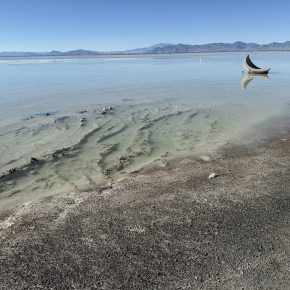
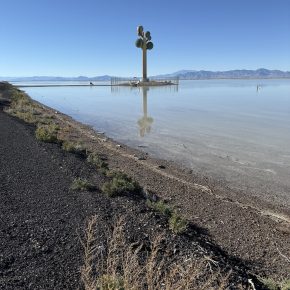
There is still no proper place to stop, though plenty of people do. Momen spent years proposing ways to change that, eventually imagining an interpretive center with parking, restrooms, a café and, most importantly, a place where travelers could sit and look into the desert without the interruption of traffic. “Most people never experience the desert when they travel,” he said. “You must go someplace alone—sitting and looking—and digest the atmosphere.” The center was never built. (A rest stop at the Bonneville Salt Flats, 15 miles to the west, achieves something similar.)
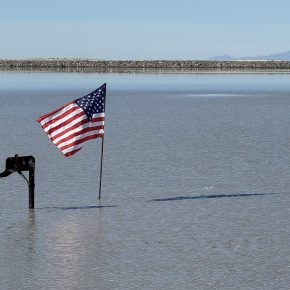
A fence eventually went up around the Tree. But rules and fences have not stopped people from responding to it. In some ways they have simply provided another surface on which to do it. Locks and other mementos now hang from the chain link. Someone has cut an opening through the fence. Someone else has placed a little Christmas tree among Momen’s enormous broken pods. For a mile or more in either direction, others have propped up sculptures of their own: stones arranged into names and messages, various pinwheels, and a lone mailbox flanked by an American flag.
How do the grandchildren feel about The Tree? What appeared alien enough in 1986 to provoke arguments over whether it violated the landscape now seems difficult to separate from this particular stretch of I-80. It has become a landmark in the old-fashioned sense: something by which travelers know where they are. See the tree? You’re almost to Wendover.
And as we have learned over and over in the years, the desert has never been empty. If you pull over, 18-wheelers wizzing by, and walk across the short isthmus to slip into the enclosure, look high into one of the crooks of Momen’s concrete branches: there’s a large bird’s nest.

The founder of Artists of Utah and editor of its online magazine, 15 Bytes, Shawn Rossiter has undergraduate degrees in English, French and Italian Literature and studied Comparative Literature in graduate school before pursuing a career in art.
Categories: Featured | In Plain Site | Visual Arts