Salt 18, the current presentation in the Utah Museum of Fine Arts’ international series of contemporary art invitationals, presents Amor Muñoz, a well-known Mexico City artist who researches the interaction of technology and culture and their impacts on each other. That she has succeeded in this can be measured by the fact that her work at UMFA is the first so-called interactive art work I’ve seen that actually works, continuously responding to even subtle viewer motions. Additionally, between the curious tower that rises in the center of the salt gallery, and the compact vitrine that shares the space, she visually diagrams the path of her discoveries and those connections she found along the way.
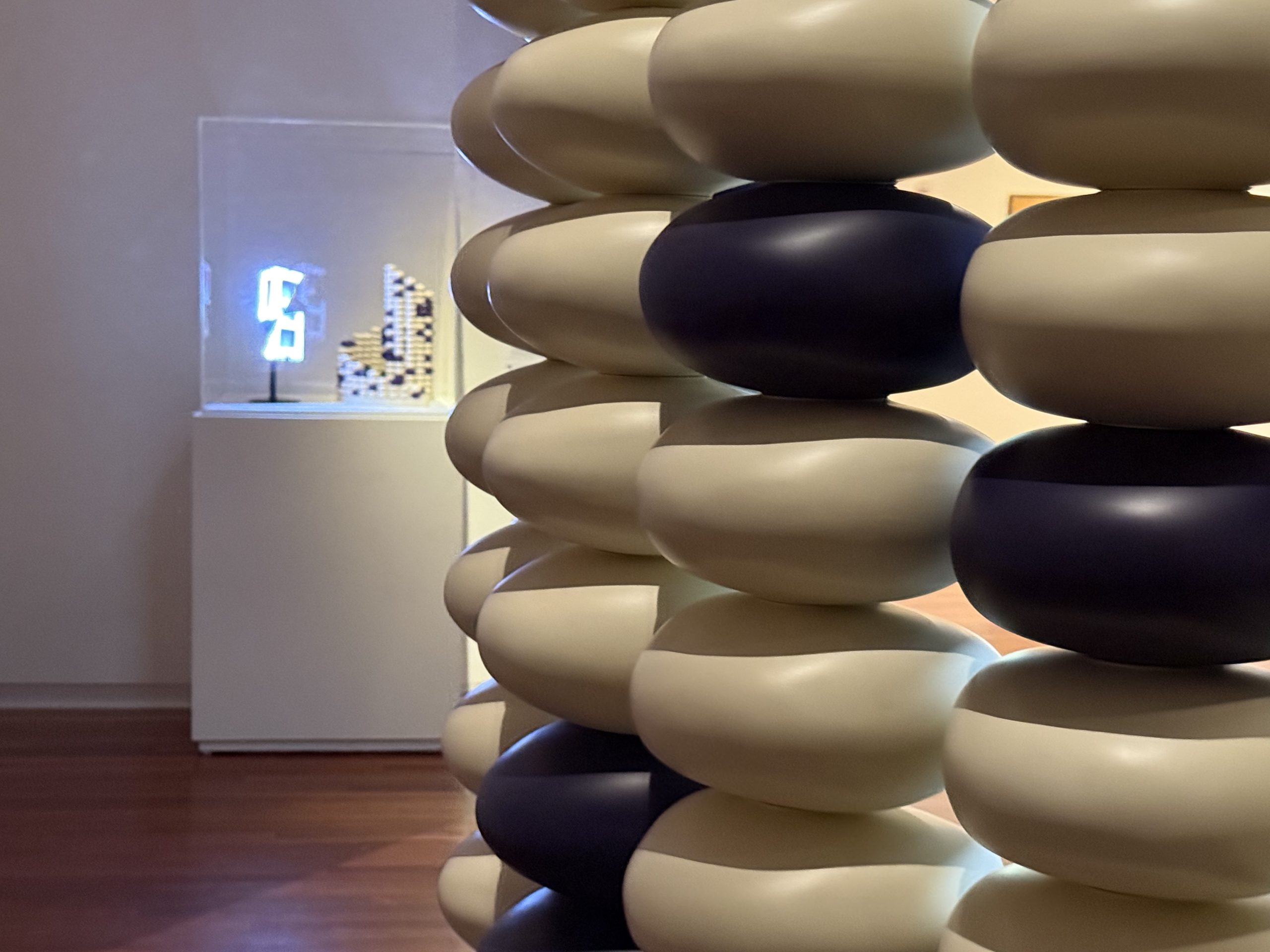
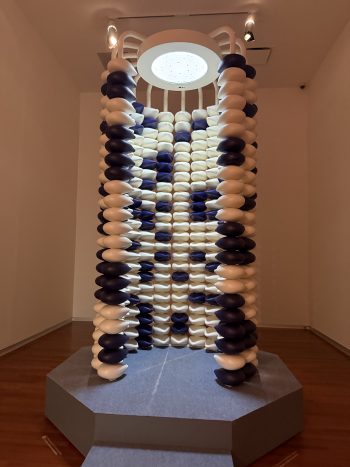
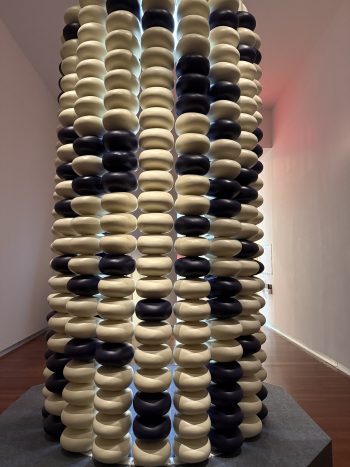
The exhibit’s central structure is assembled of brick-like black and white lozenges that might initially suggest small sandbags or stones, but in totality comprise the image of a giant ear of corn. Outside the structure, one’s cell phone (or a loaner headset available at the front desk) produces a variety of sounds that change as one circles the structure—becoming louder on approach and softer when backing away, producing a connected and coherent response. This audio-visual evocation of corn as an interactive material is the first step on a broad journey: agriculture, a scientific practice so familiar it might be mistaken for little more than a craft, forms not only the foundation of everything humans have done since its invention, but can be seen threaded through many specific technologies: not just farming, but transportation, communication, labor, marketing, storage, and the sharing and exchange of knowledge along the way.
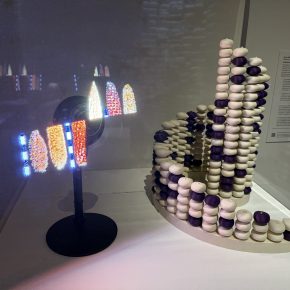
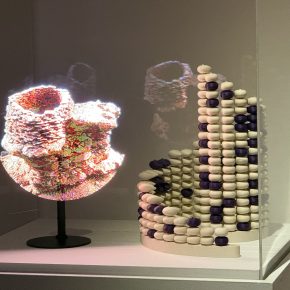
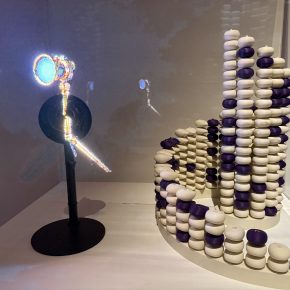
A next step in the path of Amor Muñoz becomes visible when looking into the vitrine that stands to the right of the gallery entrance. Here can be found one of the models that the artist created in her search for the proper shape of her building, suggesting that the ear of corn was not her first, fundamental version. Also here are a set of rapidly changing holograms—objects that seem palpably real and yet float weightlessly in the interior space and come and go, one after another like so many ideas. These include slender ears of corn in many colors, together suggesting the long development of the crop that made the vibrant, wealthy societies of Central and South America possible. This will be followed by several architectural ruins, including the familiar form of El Caracol Observatory at Chichén Itza, displaying the tight, disciplined stonework that characterized this round drum-like structure. In another few seconds a brass kaleidoscope appears and rotates in air, looking for all the world like one of the European-invented instruments that made the Scientific Revolution possible. This is a cousin, no doubt, of the telescope, but one that uses visual data in a different way. In case there’s any question why this particular instrument appears, it’s time to enter the round, drum-like structure looming in the center of the room.
Up a couple of steps and standing surrounded by files of black and white kernels, the viewer looks up at a round screen on which, at first, nothing may appear to be happening. But soon a pattern of shapes appears, perhaps moving slowly or dancing in lively patterns. Audience members as patient and observant as an artist may discover that these colors, shapes, and movements respond to their own articulated movement within the tall space.
Elotl, the Nahuatl word for an ear of corn, which became elote in Spanish, names the familiar result of thousands of years of cultivation that transformed a wild grass into something closer to the form we see today. Looked at closely, with an open mind, it bears a strong resemblance not only to the Mayan structures at Chichén Itza but also to the celebrated stone walls of Incan architecture. Considering how the same construction that packs kernels together on an ear of corn so tightly that no antagonistic element can easily penetrate or break in, resembles those baffling stone walls, which fit together so tightly not even earthquakes have affected them, the ear of corn then forms a kind of paradigm of the Early American architecture that followed and a connection to a host of fundamental construction applications.
The seven-syllable title for Muñoz’s structure, “KaleidescopElote” (from the Greek by way of Spanish), refers both to the beautiful forms generated visually within the structure and to the kaleidoscopic associations Muñoz has uncovered in the history of corn. While it makes a daunting collection of letters, it’s actually quite a rhythmic, indeed musical pleasure to say out loud or hear, and as such is emblematic of the satisfactions to be found at UMFA and SALT 18 until June 6th, 2027.
The UMFA’s staff is eager to make Amor Muñoz accessible to viewers who may not share its digital sophistication, so that while anyone with a cell phone can follow the diagrams that unlock its more elaborate sonic qualities, or simply approach its interior visuals directly, the museum has loaner equipment at the front desk as well as available docents to steer one through its wonders.
salt 18: Amor Muñoz, Utah Museum of Fine Arts, Salt Lake City, through June 6, 2027.

Categories: Exhibition Reviews | Visual Arts