

Gilmore Scott at his home north of Montezuma Creek, on the Navajo Nation.
When Gilmore Scott got in trouble at school, he had to help the teachers explain his misdeeds to his mother.
The youngest of six children, Scott grew up in Blanding, Utah, where his mother raised the family on her own and worked as a cook for the San Juan School District. At home, they spoke Navajo. “I never heard my mom speaking in English,” he says. When she was called to school, the teachers had to deliver their account through Scott. Was there any temptation to soften the translation? “No way,” Scott says. “She’ll find out.”
Decades later, Blanding’s new elementary school commissioned the two largest paintings Scott has made: six-by-four-foot works depicting Blue Mountain and Bears Ears, the landscapes of his youth. He and his wife had been saving for a studio, but the pandemic consumed those savings. For now he paints at his kitchen table. Without enough space to work on canvases that large, he painted them unstretched. “I had to do an old school style and roll it, and roll it, unroll it, unroll it, and paint it,” he says. “It wasn’t until I was completely done that I put them on stretchers.”
Much of Scott’s work begins small. He makes miniature paintings that he mounts on wooden blocks, testing compositions and colors before going larger. Painting an idea, rather than leaving it in a sketchbook, keeps it moving. “This forces me to sit there and paint something nice,” he says, “and just continue working the idea.”

Scott works out ideas in miniature.
He lives in a modular home on a hill north of Montezuma Creek, on the Navajo reservation. It’s the land of his wife’s family. Her grandmother lives nearby, her mother just to the south, an aunt farther down toward the road. Living among his wife’s relatives follows an arrangement his mother explained long before he married: he would leave her home and join his wife’s family. She had been determined that growing up in Blanding would not mean losing their language or culture. She took the children back to the reservation for ceremonies, reminding them of the country southwest of Bluff, across the San Juan, where she came from. “This is where I grew up. This is where I lived,” she would tell them. “This is where you’re from.”
His mother presented the paths plainly: “You’re either going to stay down here and learn this or you’re going to go up to school and learn that.” An older brother learned several ceremonies and earned the respect that came with that knowledge. Scott went away to school. Coming home, he struggled to catch up with what his brothers knew. He assumed there would be time. “They’ll be here forever,” he remembers thinking. “I’ll figure it out.” Then his brother died. Knowledge Scott had expected to learn was suddenly beyond his reach. “It’s just not like you can go up to somebody and say, ‘Hey, teach me this,’” he says. “It’s just not how it’s done.” The pandemic enlarged that loss. “A lot of people who we thought would be our teachers are gone.”
Art had taken him away. His high-school art teacher in Blanding told him, “You’re never going to sell art here.” His teacher figured the locals were more likely to buy guns and ATVs. At the College of Eastern Utah in Price, James L. Young took him under his wing. Working in the art department, Scott cleaned galleries and learned to take down exhibitions, repack artworks and ship them back to their makers. As the two-year program drew to a close, he considered continuing his education in Santa Fe. Young suggested Utah State instead, offering to help him stay another year at CEU devoted to art classes if he would consider the move.

Scott lives with his family on a hill north of Montezuma Creek.
Scott visited Logan and agreed. During the extra year in Price, he took everything he could: pottery, sculpture, painting, drawing, photography and printmaking. He recalls working from intaglio to silkscreen and pulling a print from a lithographic stone. That experience shows in his paintings’ strong design sense, the way patterns organize a composition and landscape forms become shapes.
While he was in college, a Forest Service job put him on a trail crew. Within the first week, a supervisor asked whether anyone wanted to join the understaffed fire crew. “Yeah, I’ll try it,” Scott said. He completed his training and joined an initial attack crew, among the first to reach a fire and put it out. He continued after moving to Utah State, learned to rappel from helicopters, and worked in Idaho and northeastern Utah before returning to the forest around Monticello.
Talking about those years, Scott becomes almost giddy. Again and again, he calls the work fun. “Your day to day is always changing,” he says. “You’re not going in from a regular nine to five.” When the monsoons arrived, lightning could set off one small fire after another. He remembers a day when the crews dealt with 18. “Just boom, boom, boom,” he says. “Knock them out, knock them out, knock them out.” The work took him to large fires in Northern California and Idaho, prescribed burns in the South, and a saw-team assignment after Hurricane Katrina in Gulfport, Mississippi.
But supervision changed the work. He became responsible for young people joining his crew, and was told he needed to spend more time in the office. “It became stressful towards the end,” he says. A manager advised him to stop if it was no longer fun: he could hurt himself or someone else.
There was also the time away. Early assignments meant 21 days out, two days home. When his two daughters were small, he remembers having to rush home on days off to pick one up from school. “My wife and I started a family,” he says. “I was like, ‘Man, I’m gone.’”

Scott’s kitchen table doubles as his studio.
“I was probably producing one piece of work a year, if that,” he says of his time fighting fires. Family members collected the paintings; occasional competitions and Forest Service T-shirt designs kept him connected to art. Finally, he decided: “I think I can do better as far as what I’m doing here, if I concentrate on doing art.” He left the Forest Service in 2010, after about nine years.
“Nobody told me that there were art shows to go to,” he says. “It’s something I figured out on my own.” A potter related to him through their clans urged him to sell at Four Corners. Scott brought small watercolors and a compressor for airbrushing T-shirts. Learn to talk to customers, learn to sell, his friend told him. Tourists watched him paint a shirt and asked how long it would take. Half an hour? They would wait. A show at the Natural History Museum of Utah introduced him to arts organizers elsewhere in the state. Recognition followed: acquisitions by Springville Museum of Art and the St. George Art Museum, a solo exhibition at St. George, and a monetary award in California in 2025.
Nearby Bluff offered a counterexample to his teacher’s warning. “That little community there has been awesome,” Scott says. “It’s a complete 180 between Bluff and Blanding.” At Twin Rocks Trading Post in Bluff, Steve Simpson had spent years asking him to paint restroom murals. Then the pandemic canceled Scott’s shows. Simpson was remodeling and renewed the invitation. Scott made two murals and now tells visitors to “ask Steve to go see the meditation room.” Simpson also opens a room for him to meet collectors. Scott sends buyers photographs and asks which way they are traveling. Other transactions happen in Durango parking lots.
Shows take him to Santa Fe, Phoenix, Jackson, Salt Lake and beyond, generally once or twice a month. Even now, he waits nervously for the first sale, then calculates when he has recovered booth fees, gasoline and lodging. Being able to pay for several shows in advance “was a long time coming.”
Buyers sometimes ask why the same mesas and buttes keep appearing in his paintings. “Because that’s what you see when you look out the back door,” he tells them. His mother was a rug weaver, and the patterns he grew up with continue to shape his paintings. “A lot of my work is based on rug patterns as well,” he says. Geometry organizes the mesas and skies, bringing the landscape into a vocabulary learned partly at home, partly in the classroom.
In the Forest Service, lightning meant the next fire. In his paintings, storms also carry the teachings he learned growing up. As he shows us dark clouds and lightning, cooler passages of violet and blue, he explains why he sometimes paints the storms separately and, lately, brings them together. “For us, traditionally, the dark cloud storms with the lightning is considered a male storm,” he says. The first spring thunder shakes the earth and wakes animals, insects, plants and people. He was taught to go outside, stand on the earth and stretch. The female storm brings calmer, soaking rain.
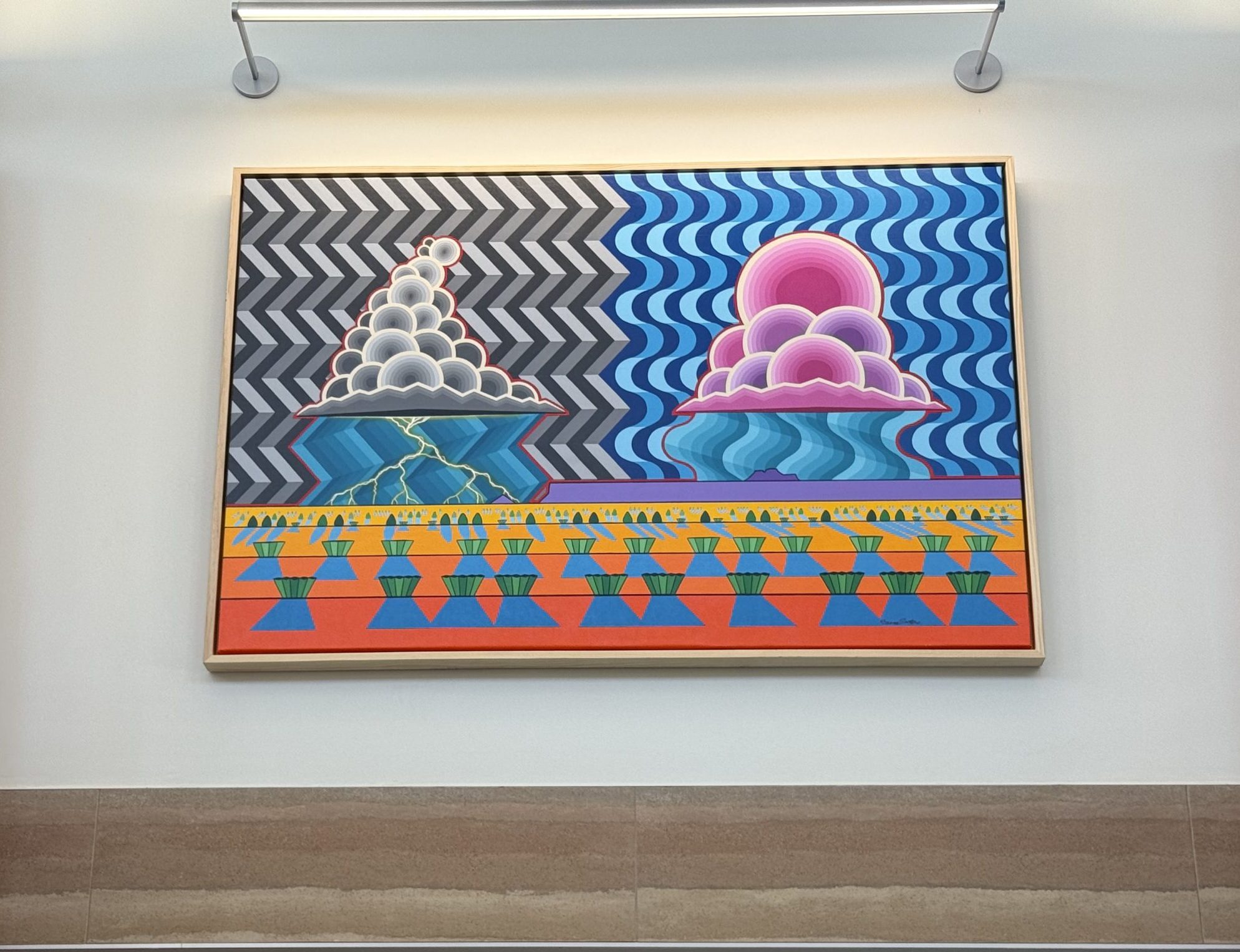
One of Scott’s storm paintings, installed at the new Blanding Elementary School.
During the monsoon, the loud, windy storm passes first, followed by settling rain. “It’s awesome when it rains out here,” he says. Afterward, frogs in the ponds a quarter mile from the house call so loudly the sound echoes across the mesa. His colors distinguish the two storms. Ceremonial symbols exist for those storms, but “I won’t ever paint” them, he says. They belong in ceremonial sand paintings, seen by medicine people and the patient, then returned to the earth.
In some paintings, masked holy figures appear alongside the weather. Virga—the rain trailing beneath clouds—has another meaning in the teaching he describes: holy people letting down their tied hair to bring rain. Clouds also hold bison in a series he calls his “bread and butter pieces.” He is testing how a new pattern from the storm paintings might accommodate those animals.
In the stories he recounts, Comb Ridge forms part of Mother Earth’s backbone. Sleeping Ute is the Sleeping Giant, associated with the Gambler and the hero twins. Shiprock carries another story involving the twins, a flying creature, and the eagle and owl. The San Juan is the old-age river. The widely circulated view of Bears Ears shows two buttes. From the angles he grew up knowing, he sees the bear’s head, ears and snout. On his phone is a photograph his daughter took on the drive home from Blanding: Bears Ears from that angle, rain trailing from the clouds behind it. He plans to use it for a painting. “I always produce the Bears Ears the way I grew up looking at it,” he says.
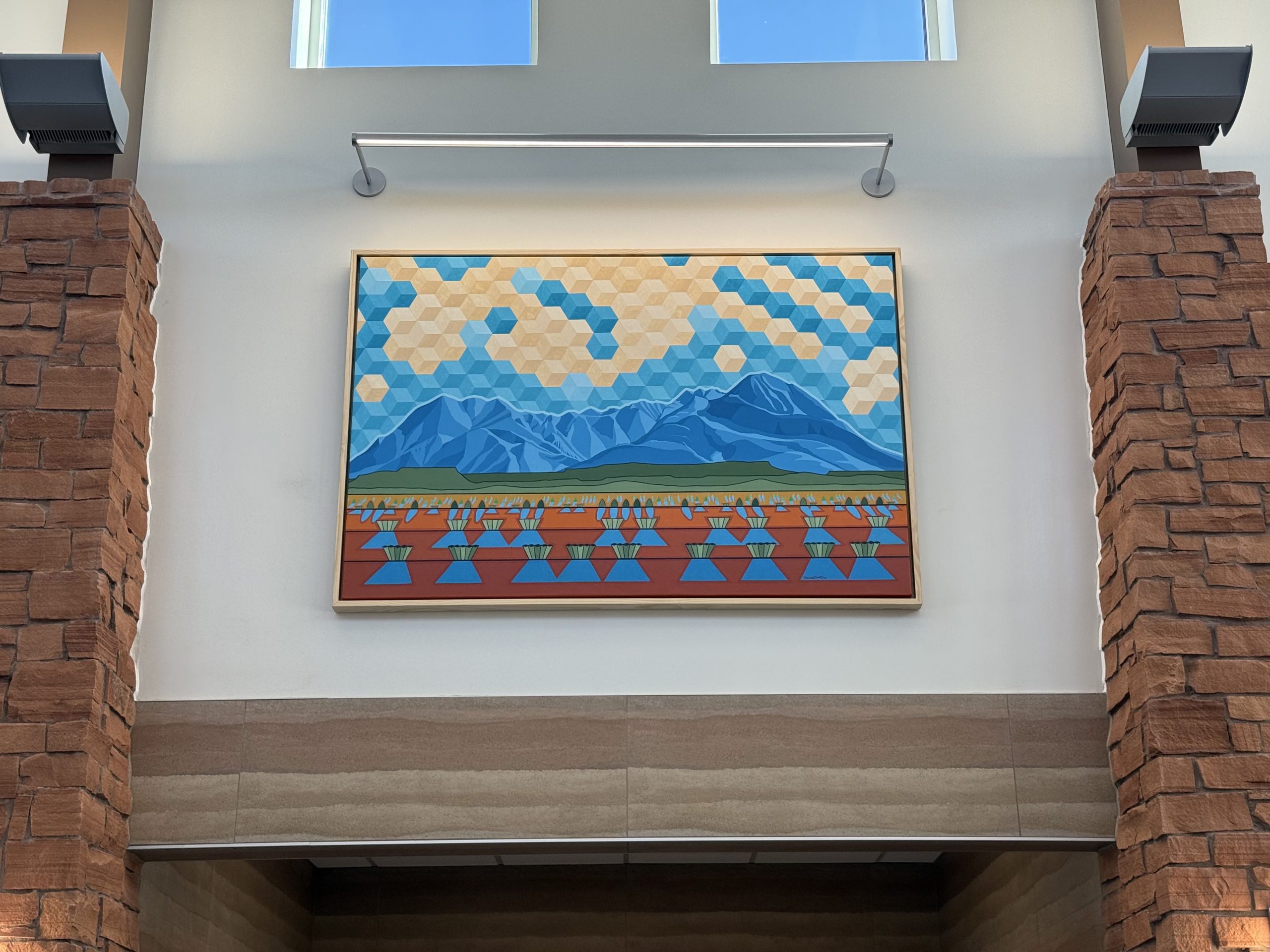
One of two six-by-four-foot paintings Scott created for the new elementary school in Blanding depicts Blue Mountain, a landmark of the landscape where he grew up.
His work has found public homes close by, in the health clinics in Montezuma Creek and Blanding. At Montezuma Creek, a painting of a female figure was enlarged digitally into a mural; imagery from his work appears in glass etchings, too.
At his most recent Santa Fe Indian Market, he nearly sold out. In the past few years, collectors have begun waiting at his booth before sales open at 8 a.m. “They’re waiting for me,” he says, still sounding surprised. Back home, he is painting to replenish his inventory, but he resists turning that demand into a reason to rush. “I definitely take my time to do the work,” he says.
When we visited, a commissioned canvas had just been stretched and gessoed, and it was waiting to dry before he could start painting. It is headed for Salt Lake City, when he comes north for the market at the Natural History Museum of Utah. A week after that he’ll be in Bluff, for the annual arts festival.
“I plan to paint as long as I can paint,” he says, “and see where it goes.”

Gilmore Scott will be in Salt Lake City for the Indigenous Art Market at the Natural History Museum, Oct. 10-11 and in Bluff, Utah for the Bluff Arts Festival, Oct. 15-18. View more of the artist’s work https://gilmore-scott.squarespace.com.
All images courtesy of the author.
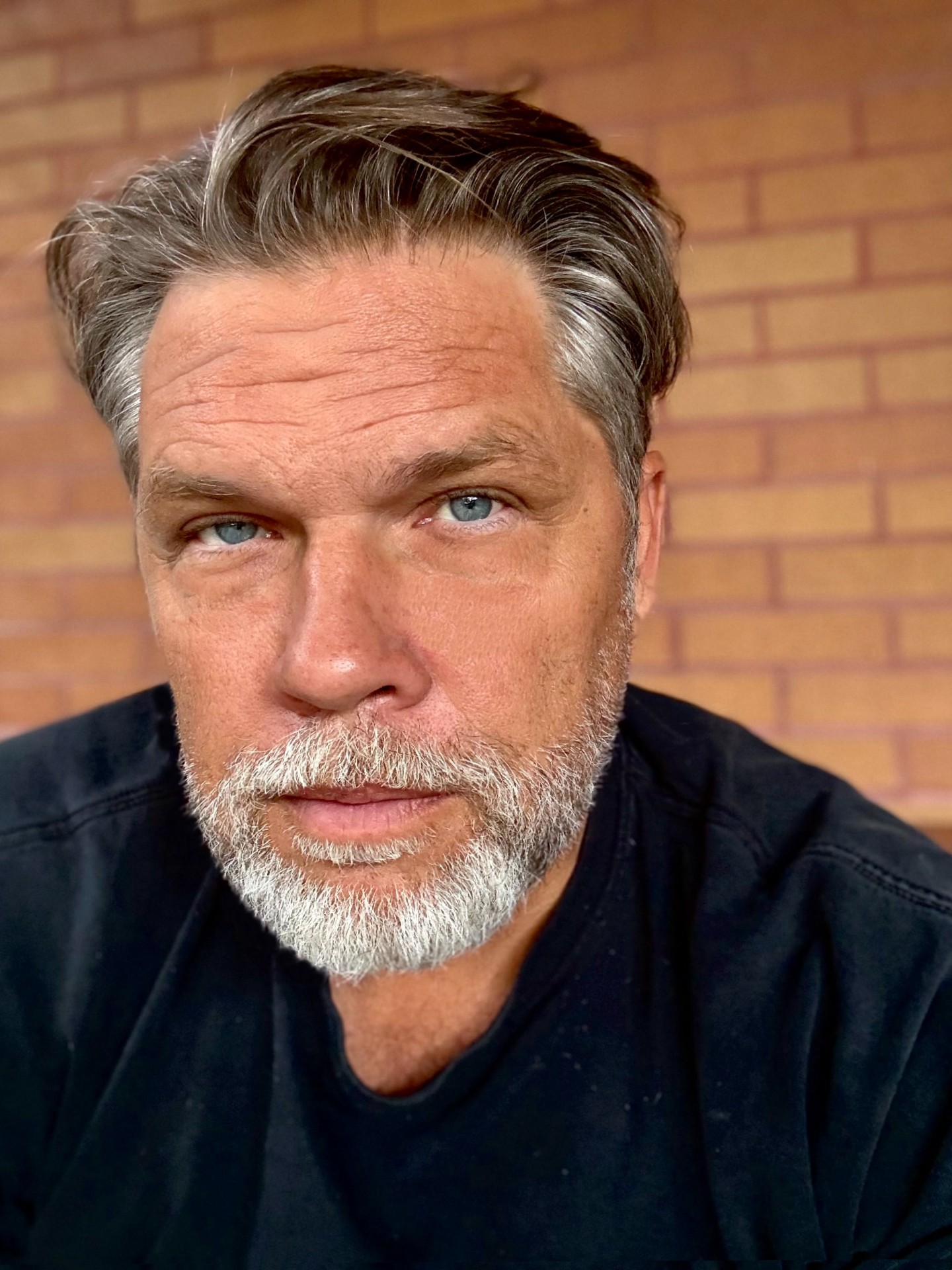
The founder of Artists of Utah and editor of its online magazine, 15 Bytes, Shawn Rossiter has undergraduate degrees in English, French and Italian Literature and studied Comparative Literature in graduate school before pursuing a career in art.
Categories: Artist Profiles | Visual Arts





Thank you for sharing Scott’s work! It is so moving.
One of Scott’s Pieces just got acquired by Salt Lake County for their visual art collection!
I read this article on Gilmore Scott because I happened to meet him at the Salt Lake Art Show 2026 – the first of its kind in Utah.
I loved talking to him. He was so warm and cheerful
He explained his painting style and theme. I would like to congratulate 15 Bytes for their research to have found him and written about him. I feel I know Gilmore more now