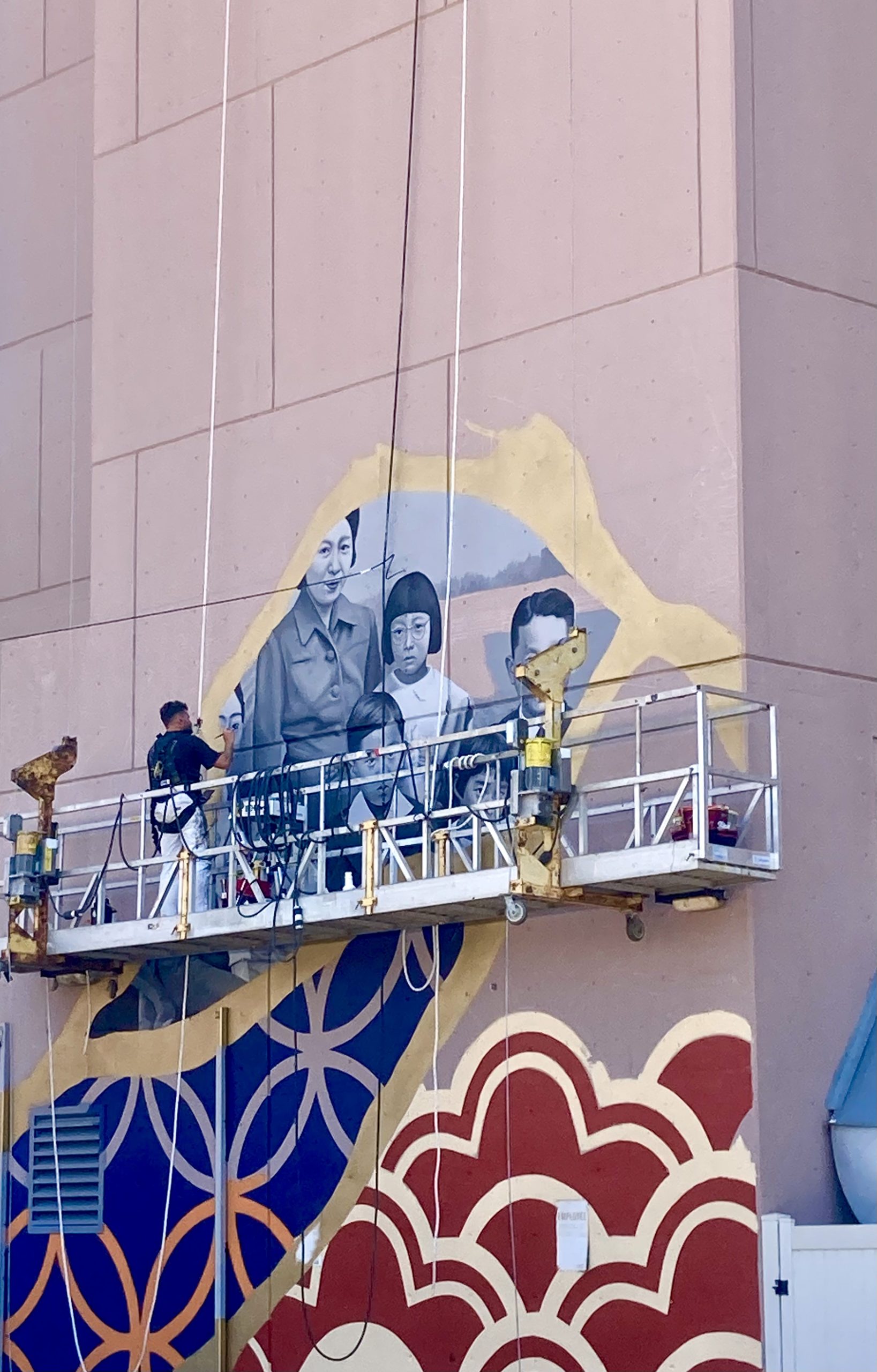
Cole Eisenhour at work on the Japantown mural which will rise above the Salt Lake Buddhist Temple at 211 West 100 South in Salt Lake City.
Work began on Cole Eisenhour‘s Japantown mural Saturday, when community members painted design elements during the Salt Lake Buddhist Temple’s Obon Festival on July 11. This week, tucked behind the temple where he’s easy to miss, Eisenhour has been at work with smaller brushes. He’s painting portraits, black-and-white archival faces rising out of a gold crack that splits the pink concrete, framed by deep blue asanoha and red seigaiha wave patterns below. The design draws on kintsugi, the Japanese practice of repairing broken pottery with gold rather than hiding the break. It’s a fitting language for the site, because the history underneath it is one of repeated breaking.
Japantown once ran from State Street and 700 West to South Temple and 300 South. It was a corridor of homes, shops, restaurants, laundries, markets and two Japanese-language newspapers. It grew from Japanese immigrants who arrived to work Utah’s railroads, mines and farms in the years after the Chinese Exclusion Act. It grew again after World War II, when Japanese Americans released from internment camps like Topaz, in central Utah, moved in. At its height, it was one of the largest Japantowns in the country, home to roughly 8,000 residents.
Nearly all of it was demolished in 1966. The wrecking balls came to make way for the Salt Palace, a new civic arena the city hoped would help anchor a bid for the 1972 Winter Olympics. At the groundbreaking that March, the master of ceremonies called it “another chapter in the inspirational Utah storybook.” The bid failed. Ironically, the 1972 Games went to Sapporo, Japan.
Decades later, former governor Calvin Rampton and Salt Lake Tribune publisher John Gallivan admitted the bid had never really been about winning. They mainly wanted publicity for the state’s ski industry. Residents became bystanders as federal urban renewal policy, the same “slum clearance” wave that gutted immigrant and minority neighborhoods nationwide, took the neighborhood apart. A dense urban corridor gave way to large, block-long developments: Abravanel Hall, UMOCA, the Salt Palace, the Delta Center, the Gateway.
The little that remained, later dubbed Japantown Street, is anchored by the Japanese Church of Christ and the Salt Lake Buddhist Temple on 100 South. Both have become commuter congregations. To preserve what remained, he Japanese Community Preservation Committee, formed by leaders like Jani Iwamoto and Judge Raymond Uno, organized starting in the early 2000s. In 2018, the community mobilized again against a mixed-use hotel development, Block 67, that threatened to encroach further on what was left. That fight produced a plan. The RDA spent five months brokering agreements between the developers, the city, county, and the Japanese American community, then funded a 15-month design process led by GSBS Architects and a steering committee of Iwamoto, Uno, and Rolen Yoshinaga. The result was a vision for cherry trees, origami-inspired sculpture, and pavement patterns drawn from Japanese design—guided by the phrase Okage sama de, “I am who I am because of you.”
That plan has been put on hold because of a bigger threat, once again connected to an Olympic bid—this time a successful one. Salt Lake City will host the Winter Games again in 2034, and Smith Entertainment Group’s roughly $3 billion redevelopment of the Delta Center and surrounding blocks, along with Salt Lake County’s parallel overhaul of the Salt Palace Convention Center, are both explicitly timed to finish before the Games arrive. The county has acquired 6.5 acres of Salt Palace land for the project, with partial demolition expected as early as 2027 (prepare to say goodbye to UMOCA). As City Weekly put it earlier this year, it wasn’t fading interest or a shrinking congregation that hollowed out Japantown the first time—it was redevelopmentand—and that same pattern is positioned to repeat as the new district takes shape around what remains of the neighborhood.
Planned streetscape improvements to Japantown Street itself—wider sidewalks, cherry trees, cultural markers—are currently paused, waiting on how the larger redevelopment resolves.
The mural, funded by the Community Reinvestment Agency and the Salt Lake City Public Art Program, is being called the redevelopment’s first visible phase, arriving while the rest of the plan is still in flux.
Eisenhour, a Northern Utah muralist who grew up in Roy and studied at Utah Valley University, was introduced to the neighborhood at this year’s Nihon Matsuri in April and has since met with Japanese American community members to shape the design. His public work tends toward narrative — a mural completed last year in downtown Logan told the story of Old Ephraim and honored Shoshone history in Cache Valley.
Japantown is his most prominent commission yet. He’s painting it on the side of the Multi-Ethnic Senior Highrise, a building Japanese American organizers spent a decade fighting to build after the first demolition took their neighborhood. As Eisenhour works his way up the 15-story wall, he’ll soon emerge from behind the Buddhist temple. Luckily, the facade faces north, and he’ll be working in the shade.
DID YOU ENJOY THIS ARTICLE?
Help make more like it possible.
VENMO us a donation at artistsofutah

Or use PayPal to MAKE A DONATION.
15 Bytes is published by Artists of Utah, a 501 (c) 3 tax-exempt nonprofit.

UTAH’S ART MAGAZINE SINCE 2001, 15 Bytes is published by Artists of Utah, a 501 (c) 3 non-profit organization headquartered in Salt Lake City, Utah.
Categories: In Plain Site | Visual Arts