It’s called the problem play. A problem because no one can agree what it is—tragedy, comedy, satire—least of all audiences, who think they’re in for one thing and discover another. So it’s rarely staged (1999 was the last time it appeared in Cedar City). But it opened the Utah Shakespeare Festival’s 65th annual season this week.
The season otherwise leans light. The non-Shakespeare plays this summer are Something Rotten! (a musical comedy explicitly about Shakespeare and theatrical ambition), See How They Run (a 1940s British farce), and She Loves Me (a romantic musical comedy). Hamlet is the one unambiguous tragic anchor. Or so you’d think.
Troilus and Cressida is set in the last year of the Trojan War where two plots run in parallel: among the Trojans, the young prince Troilus pursues Cressida with her uncle Pandarus scheming to bring them together; among the Greeks, Ulysses tries to maneuver Achilles—sulking in his tent, refusing to fight—back into battle. The two plotlines barely intersect and the title characters never quite become the center of their own play. Cressida, sent to the Greek camp in a prisoner exchange, doesn’t get enough stage time to make her choices legible. Troilus collapses into bitterness. Achilles, his vanity pricked by Ulysses’s scheming, does return to the field. And what begins like a Shakespeare comedy, laced with war satire in the vein of M*A*S*H, ends in ignoble bloodshed.
Director Carolyn Howarth sets the play in a campy 1940s war world—Andrews Sisters glamour rubbing up against military bureaucracy. She adds period music to good effect. John Harrell’s Pandarus takes to the piano for a number that suits seductive but sleazy charm. Helen becomes a USO performer, the face that launched a thousand ships reduced to a spotlight and a microphone. Lighting designer Michael Gilliam tracks the production’s tonal shifts with equal precision, the light growing harsher as the comedy drains away.
The production commits hard to the comedy in its first half, and largely succeeds. Harrell is deliciously louche—a man thoroughly at home in his own moral shabbiness, running his schemes with the cheerful energy of someone who has never once questioned whether he should. Blake Henri’s Thersites—reimagined as a war correspondent—has the comic timing to make the character’s relentless bile entertaining. Lavour Addison’s Ajax is a loving fool—lumbering through the action with no particular awareness that he’s being used, too good-natured to be villainous and too dim to be heroic. It’s a thankless role done well.
Then Hector dies. Struck down, unarmed, by Achilles’ thugs. The warriors who spent the evening posturing about honor watch in silence. The change in tone is abrupt, even if the thematic groundwork has been laid between the laughs. Most will walk away remembering the comedy, a favorite joke or scene of physical humor. But some may be haunted by the last bloody acts.
It’s a problem play. But these are troubled times. A story that begins in lecherous farce and ends in cruel tragedy may not be so foreign to our own.
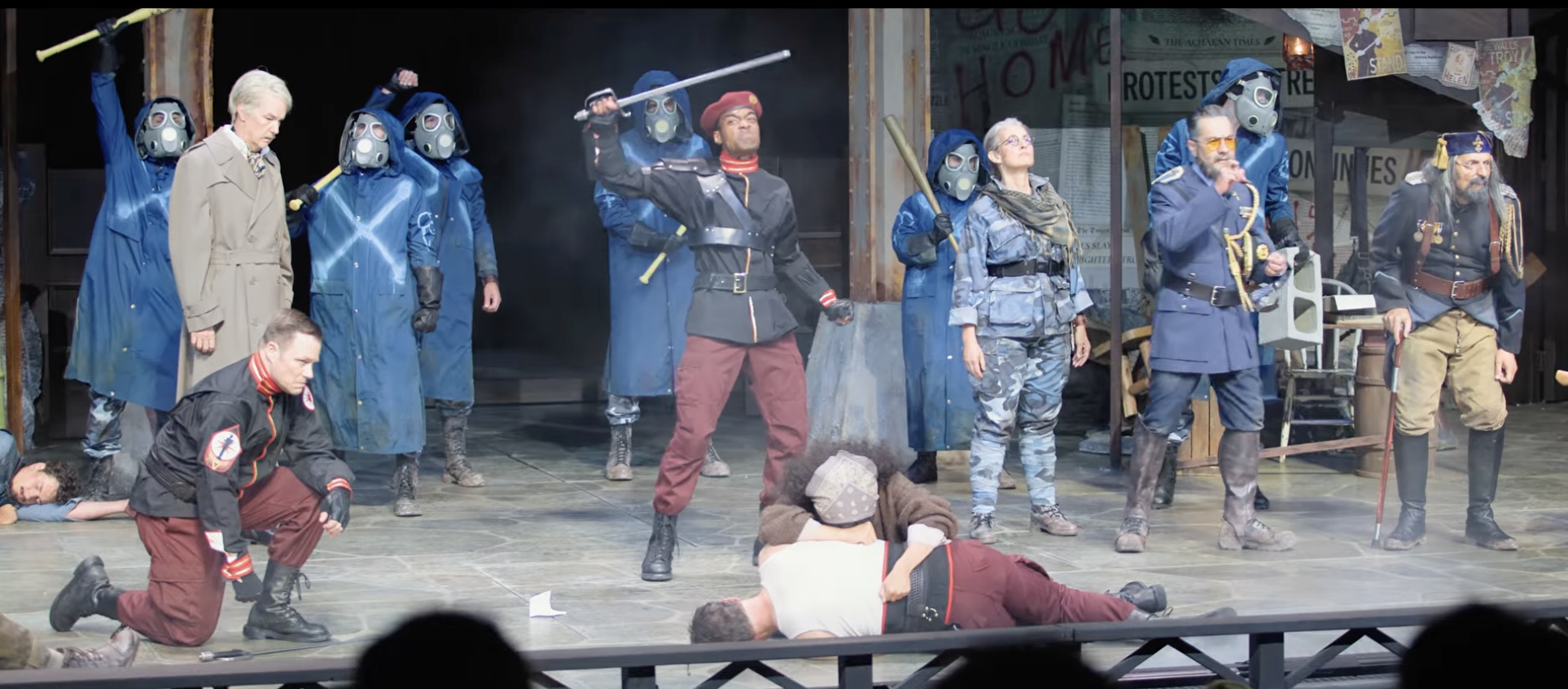
Find more information about and tickets for the 2026 Utah Shakespeare Festival at bard.org.
DID YOU ENJOY THIS ARTICLE?
Help make more like it possible.
VENMO us a donation at artistsofutah

Or use PayPal to MAKE A DONATION.
15 Bytes is published by Artists of Utah, a 501 (c) 3 tax-exempt nonprofit.

The founder of Artists of Utah and editor of its online magazine, 15 Bytes, Shawn Rossiter has undergraduate degrees in English, French and Italian Literature and studied Comparative Literature in graduate school before pursuing a career in art.
Categories: Theater