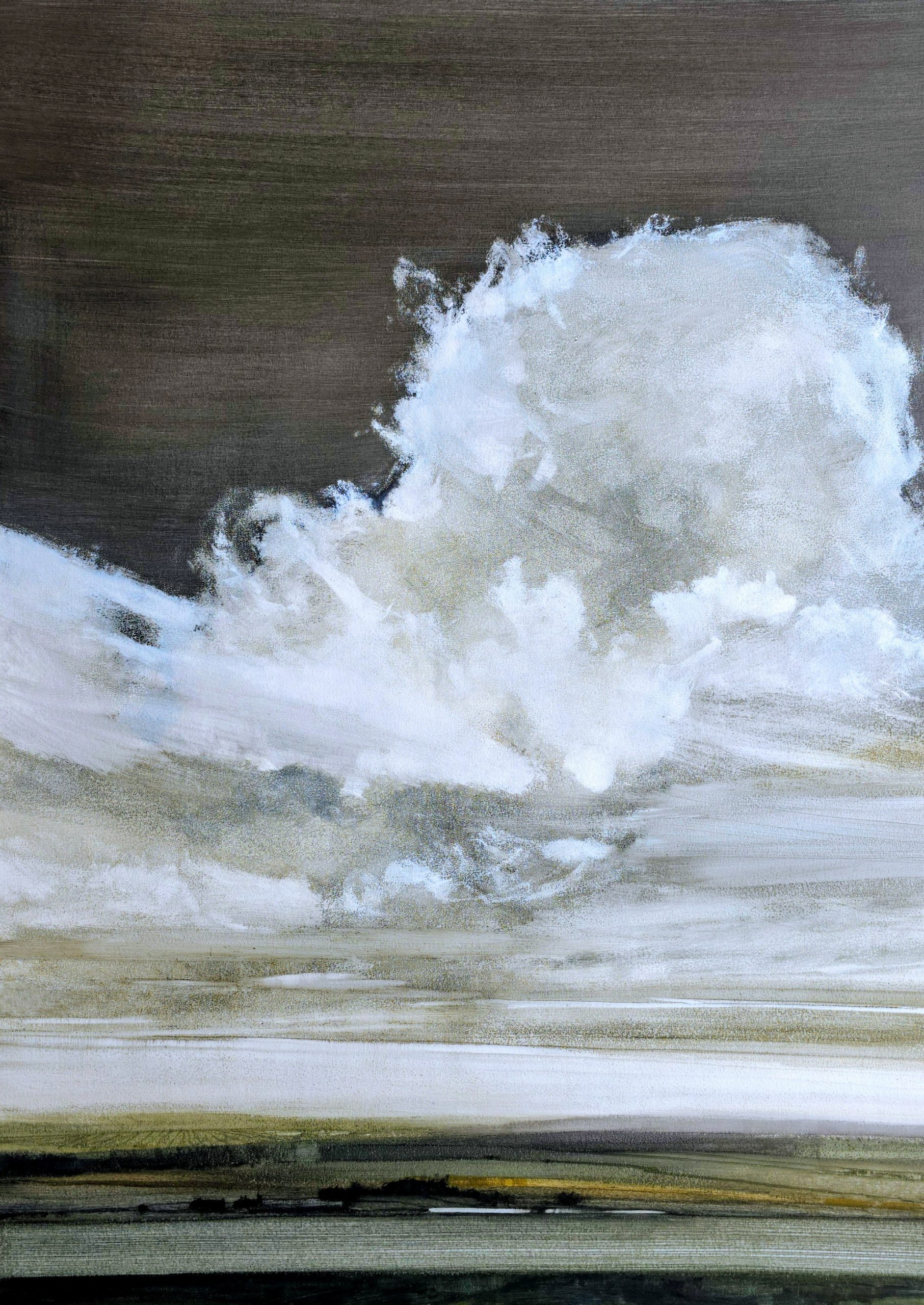
Lindey Carter, “My Favorite Weather,” watercolor on canvas, 48 x 36 in.
Lindey Carter’s large canvases anchor the upstairs space at Phillips Gallery this month. Scattered among Carter’s large pieces are smaller oils on panel by David Cassil. The two bodies of work share a register of muted atmosphere and restrained color close enough that, without prior knowledge of the show, you might take them for the same artist. Both artists are painting Utah’s other light—not the clarity the state is known for, but the gray that can settle over the valley, or the flash of deepening color in a sudden storm. Carter observes the open road and passing weather. Cassil’s subject is the city—the industrial west side of Salt Lake, the Marmalade District’s older residential fabric, the downtown core in rain.
A gallery regular, Carter has long earned admiration for small, quick atmospheric work, and in this show she demonstrates she can successfully take that feeling to a large scale. Horizontal striations in the foreground, loose gestural marks in the cloud masses—her paintings stay open even as they reach dimensions measured in feet rather than inches. “Leave It Behind” and “Where You Have Been,” both at 36×60 inches, sustain the feeling of a glance — weather seen from a moving car, a horizon glimpsed and gone—without losing the surface energy that makes her smaller work so appealing. “My Favorite Weather” and “From Where I Sit” give the sky the majority of the canvas, the horizon pressed down to a narrow band of earth, a familiar Carter move; at 48×36 and 72×48 inches this requires serious commitment to succeed.
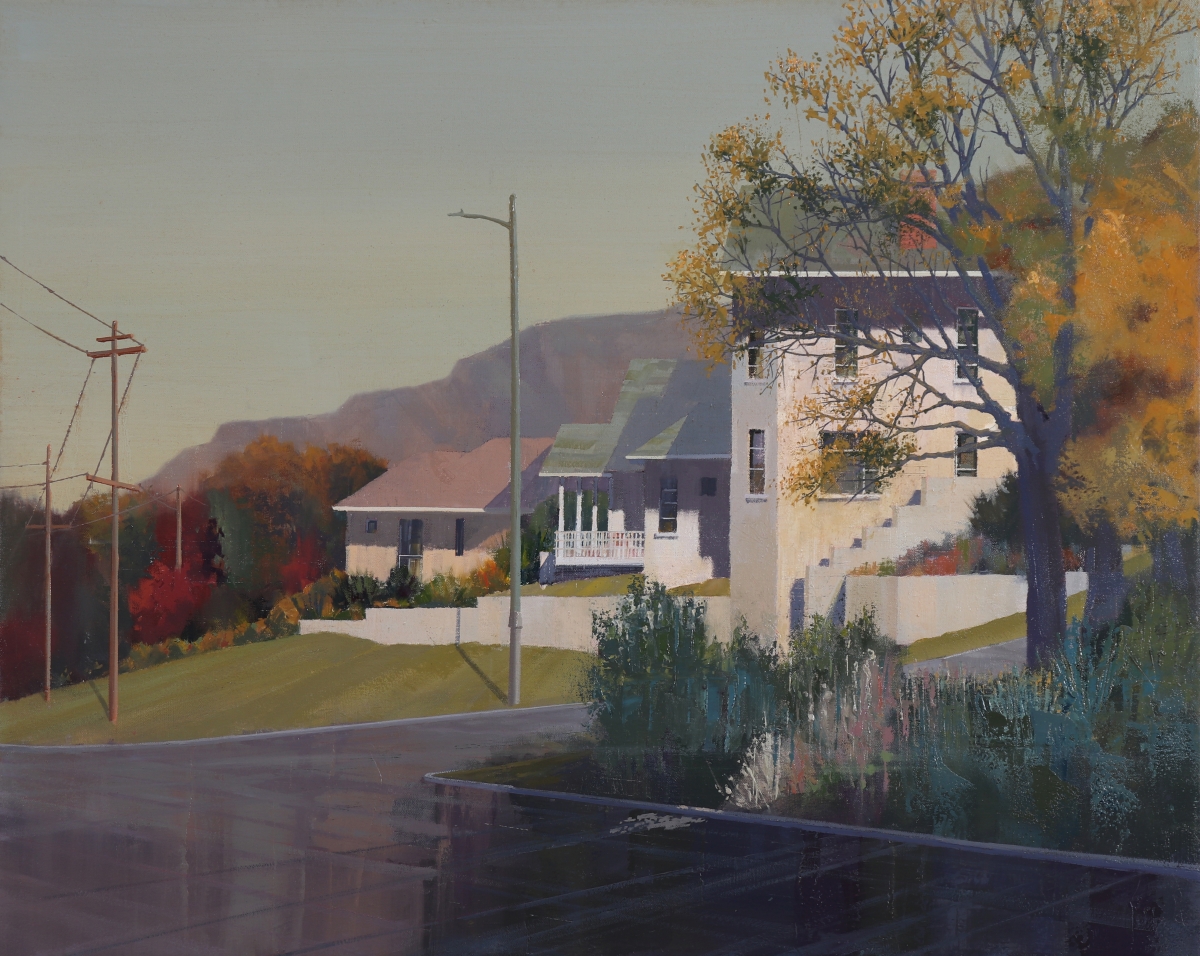
David Cassil, “Marmalade Corner,” oil on canvas, 24 x 30 in.
Cassil came to painting late. After decades as an architect, he trained at the University of Utah under John Erickson and John O’Connell, and worked with painters Paul Davis and David Dornan. His architectural background is visible in the work—he knows how buildings stand up, how facades plane against each other in three dimensions; and that structural knowledge underwrites the paintings, though he softens them in atmosphere and muted light. His Marmalade series works at neighborhood scale, documenting the older residential grain of the city with an affectionate eye. The industrial paintings find grandeur in infrastructure that most painters might pass over entirely (and, one suspects, collectors would as well). “City Rain,” the show’s largest piece, is the most obviously dramatic—rain-slicked streets, headlights pooling on wet asphalt. More characteristic, and ultimately more interesting, are the understated paintings, where the same atmospheric sensibility is held together with subtler means. He plays just loose enough with color to keep things interesting. There’s a golden gray that runs warm beneath the cooler tones, amber and ochre pushing through rather than being pushed out. Surface texture is built through the accumulation of thin layers.
Carter begins with weather and landscape, Cassil with structure and the built environment, yet both find their way to the same subdued, atmospheric territory. Together they offer a portrait of Utah that feels unusually attentive to overcast days, wet streets, and the quieter moments between spectacles—an appealing reminder that not all of the state’s beauty arrives under clear blue skies.
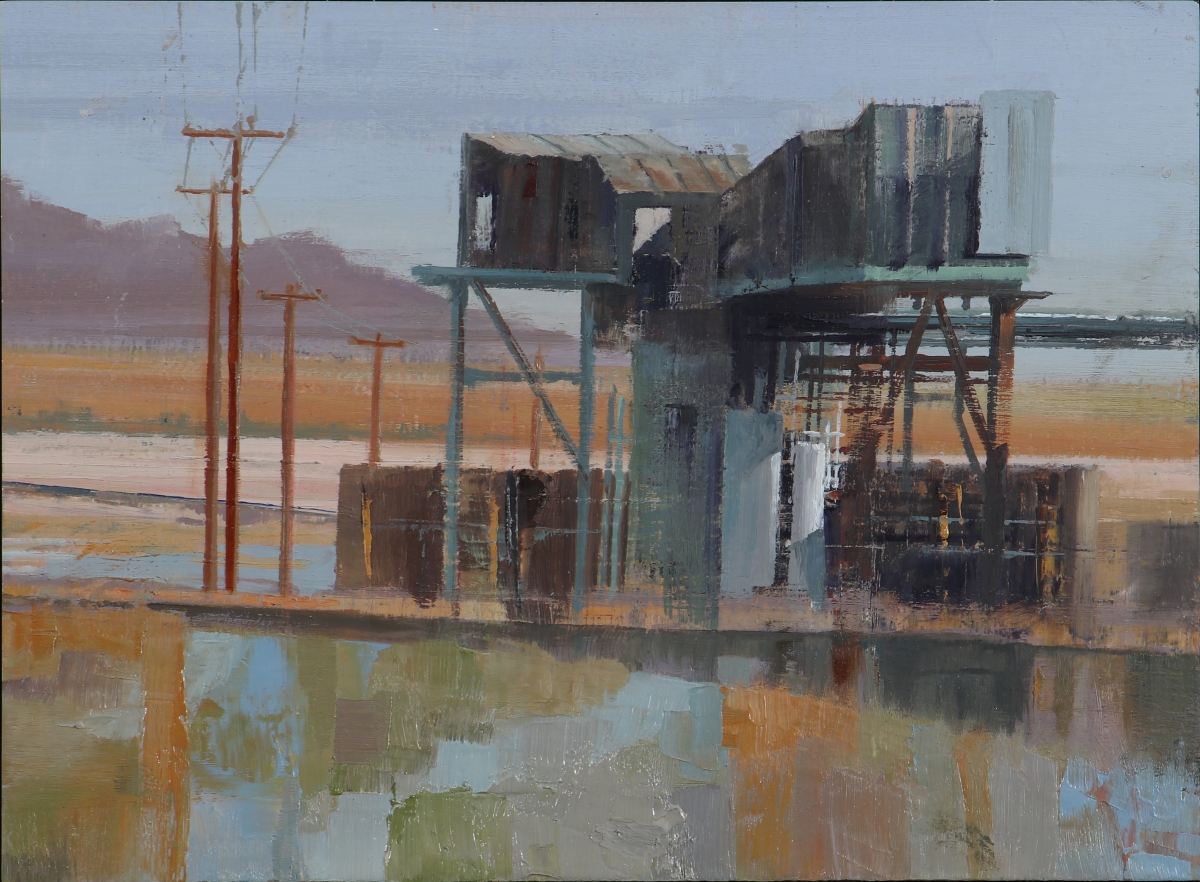
David Cassil, “High Desert Industrial,” oil on panel,7 x 9 1/2 in.
Lindey Carter & David Cassil, Phillips Gallery, Salt Lake City, through July 12
DID YOU ENJOY THIS ARTICLE?
Help make more like it possible.
VENMO us a donation at artistsofutah

Or use PayPal to MAKE A DONATION.
15 Bytes is published by Artists of Utah, a 501 (c) 3 tax-exempt nonprofit.

The founder of Artists of Utah and editor of its online magazine, 15 Bytes, Shawn Rossiter has undergraduate degrees in English, French and Italian Literature and studied Comparative Literature in graduate school before pursuing a career in art.
Categories: Exhibition Reviews | Visual Arts